Login
Signup
News
The Arab Network organizes an international conference on “The role of NHRIs in following up the implementation of the SDGs” during the period from 26-27 June in Sharm El-Sheikh
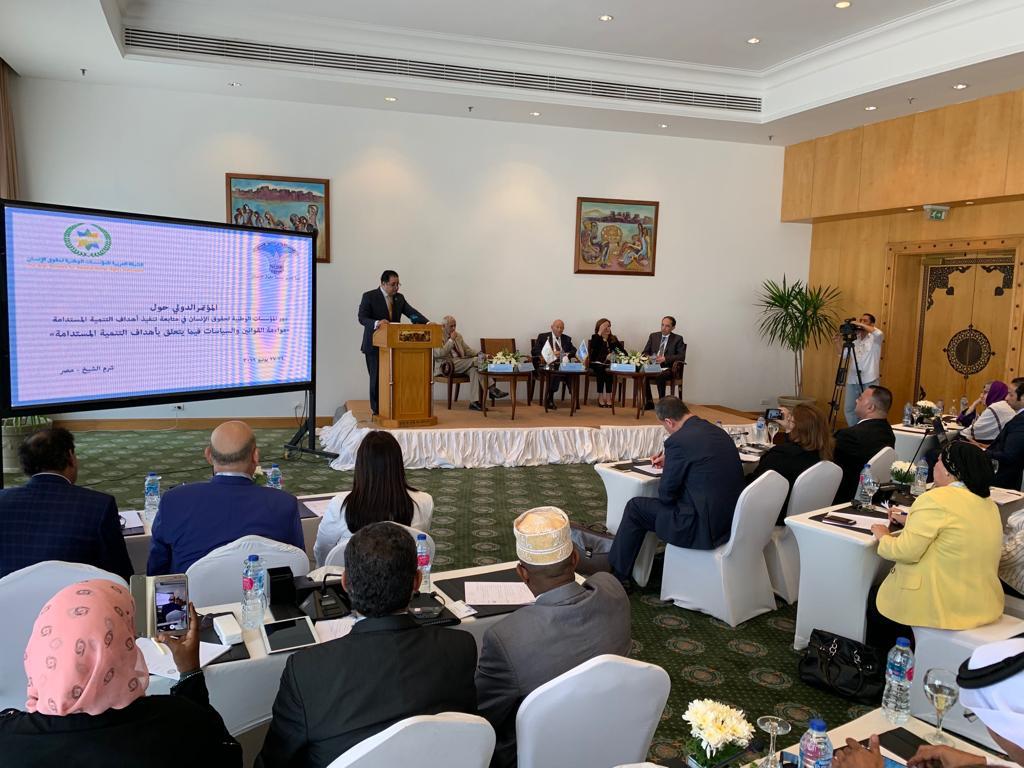
The Arab Network, in cooperation with the NCHR, organized an international conference on the role of NHRIs in following up on the implementation of SDGs “harmonizing laws and policies regarding SDGs” on 26-27 June 2019. Participating in the conference were more than 20 national Arab, European, African and Asian national institutions. This is in addition to the High Commissioner for Human Rights, the United Nations Development Program, the United Nations Economic and Social Commission for Western Asia (ESCWA), the African Network of National Human Rights Institutions, the League of Arab States, a number of civil society organizations, international organizations, Arab and foreign embassies, and relevant government agencies.
In his opening speech, Mr. Mohamed Fayeq – President of the ANNHRI and Chairman of the NCHR reviewed the achievements made by the Network and its member institutions in promoting the SDGs 2030, and the extraordinary efforts made in preparing them, hoping for a new path for the world that will advance all nations. He referred to the years that have passed in the life of this program and the magnitude of the challenges that rarely gather simultaneously, taking local, regional and international dimensions. The Middle East and Africa bear the most consequences of such challenges. Fayeq added that the most important of these challenges are terrorism, armed conflict, trade wars, climate change, and foreign occupation. He also touched on the paradox facing the Palestinian cause which combines occupation and military aggression since the launch of the 2030 Agenda for SDGs despite the commitment of the international community to “not to leave anyone behind.” This is a challenge that is storming all the standards of international human rights law and international humanitarian law, wasting all UN resolutions towards no horizon for the Palestinian people to recover their legitimate and inalienable rights. His Excellency also reviewed what Egypt have achieved on the path of sustainable development, and in in relation to which a voluntary report has been submitted to the high-level political forum.
In the same context, Mrs. Ruwaida Al-Hajj, Regional Representative for Human Rights at the Regional Office for the Middle East and North Africa, stressed, in a speech on behalf of the OHCHR, that the activation of the synergistic relationship between Human Rights and SDGs is essential to strengthening each other. She added that, “On the one hand, the Human Rights influence the directing and the legal framework binding to address the multidimensional goals of the 2030 Agenda. On the other hand, SDGs can be a roadmap directed towards achieving the targeted results for the realization of Human Rights.” Ruwaida called for activating the recommendations of the “Merida” conference and its emphasis on capacity building and exchange of knowledge, and the use of national, regional and international human rights mechanisms to assess and guide the implementation of the Agenda. She further touched on how to activate the Paris Principles to support and implement the 2030 Agenda. She said that, “It is important to form national human rights action plans as another mechanism that national institutions can benefit from when they contribute to monitoring national progress towards achieving SDGs.” She further stressed on the importance of the role of the universal periodic review, the treaty monitoring bodies and special procedures as well as supervisory bodies of the International Labour Organization. She also stressed on the role of national institutions in shaping global and national indicators.
the final statement of conference of the SDGs