Login
Signup
News
The Arab Network organized a workshop on “Elections and the role of national institutions in monitoring elections” in Sudan during the period from 21 to 22 May 2017
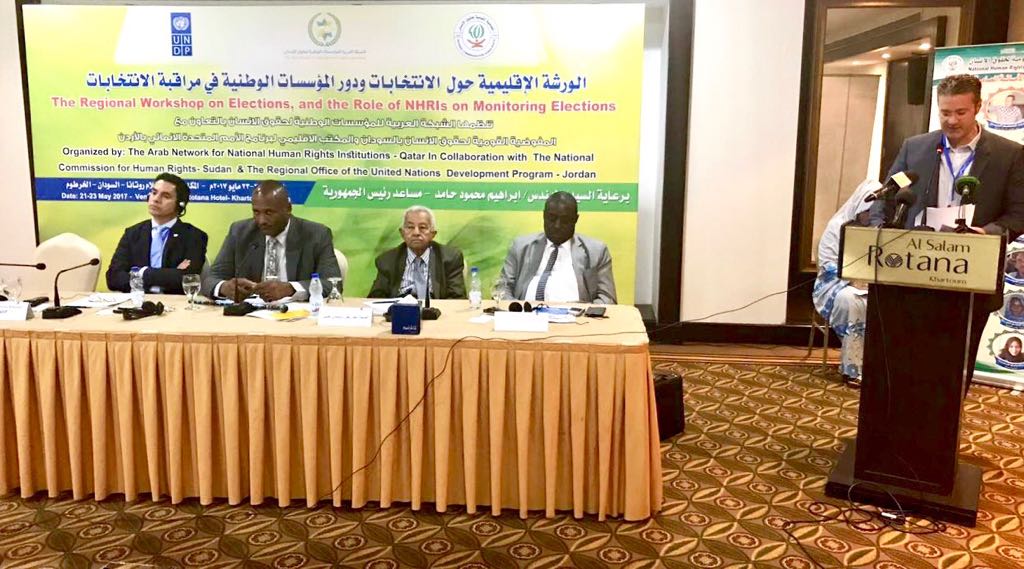
The Arab Network organized a workshop on “Elections and the Role of National Institutions in Election monitoring” during the period from 21 to 22 May in Khartoum, Sudan, in cooperation with the National Human Rights Commission in Sudan and the United Nations Development Program (UNDP). The opening was attended by Major General Abdul Rahman Al-Sadiq Al-Mahdi, Assistant to the President of the Republic of Sudan in the presence of ambassadors and experts from Arab countries and experts from the United Nations Development Program in the field of election monitoring.
The workshop aimed at strengthening the role of national institutions as election observers, exchanging experiences and best practices for national institutions and other organizations in monitoring and observation of elections in the region and beyond, as well as strengthening the capacities of national human rights institutions to monitor elections, raising awareness about the difference between election monitoring, observation and supervision, strengthening the professional competence of national human rights institutions in electoral observation and oversight missions, exchanging of experiences and best practices in electoral observation and monitoring, and contributing to the development of the methodology of monitoring the elections in the Arab countries.
In its conceptual framework, the Network noted that the exercise of the right to vote is one of the fundamental human rights, particularly civil and political rights, as well as economic, social and cultural rights. Accordingly, participation in electoral processes has become an international practice of human rights bodies, and an attempt to promote respect for the right to vote and other broader rights, which must be respected during electoral processes.
The workshop was attended by a number of members of the Arab Network, the League of Arab States and the elections monitoring and observation groups at the national and international levels, The United Nations Development Program (UNDP) as well as national human rights institutions from Arab countries to share knowledge and raise awareness about election observation, as well as to share with participants the experience of national institutions and electoral monitoring and observation groups from other regions. The workshop devoted space for comparison and discussion, enhancing awareness and understanding differences between monitoring, observation and supervising elections.
During the workshop, a series of working papers and panel discussions on election monitoring were held, covering an overview of democracy, monitoring, observation and supervision of elections and the monitoring mechanism as a tool for promoting democracy, human rights and good governance, In addition to discussing the criteria and differences between the monitoring, observation and supervision of elections and the International Principles for Election Observation (LAS).
The workshop also dealt with the monitoring of elections and the role of national institutions in promoting human rights in elections as well as electoral obligations, the electoral cycle and the role of national institutions (by OHCHR) and mechanisms for reporting on human rights issues related to elections in international mechanisms, impact of the election monitoring on human rights (by IDDH), monitoring elections on the ground and monitoring elections from a human rights perspective: the pre-election phase. The workshop reviewed presentations on relevant human rights and what to look for during the pre-election phase as well as pre-election observation: field experience.
In a group activity during the workshop, participants were divided into groups to discuss evaluation areas during the pre-election phase, and come up with a list of issues and indicators that national institutions should consider during election observation.
The workshop produced a set of recommendations related to the electoral process. In terms of the electoral cycle, especially in matters of strategy, it recommended the importance of reviewing the laws, legislation, voter registration, and electoral constituents, as well as the need to write reports in a way that affects the policies of the amendment of laws and legislation. The relationship with Elections Management Bodies should be cooperative, coordinating and complementary in order to achieve the desired goal of the electoral process, namely to promote and protect the right of political participation through the electoral cycle and provide advice and recommendations through monitoring reports, in addition to the need to cooperate with civil society institutions and exchange knowledge as needed, in particular through civic education and voter education activities. Recommendations also focused on the need to raise awareness on human rights in elections in Arab societies, develop a methodology for monitoring elections through national human rights institutions, develop a standard declaration of principles and a code of conduct to monitor human rights in elections, and encourage and vigorously continue to hold similar regional workshops for national human rights institutions on an annual basis and with the support of the United Nations