Login
Signup
News
The Arab Network for National Human Rights Institutions organized a seminar on “Implementing the Orders of the International Court of Justice: The Responsibility of Third States in Preventing Genocide in Gaza,” on the sidelines of the fifty-fifth session of the Human Rights Council
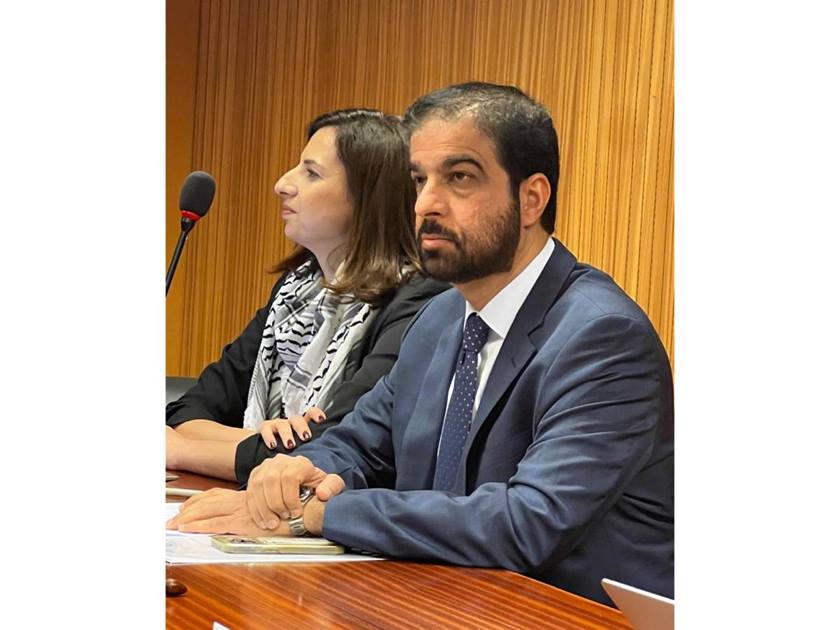
Geneva..
Mr. Sultan bin Hassan Al-Jamali, the Secretary-General of the Arab Network for National Human Rights Institutions, emphasized the need to implement the orders of the International Court of Justice and to hold countries accountable as third parties in international law. This would contribute to preventing genocide in Gaza, stopping aggression, unifying efforts to open safe passages for aid and relief organizations, and cooperating in holding Israeli war criminals and their accomplices accountable.
He made these remarks in his opening speech at the seminar organized by the Arab Network for National Human Rights Institutions, the Independent Commission for Human Rights in Palestine (a member of the network), the Palestinian Center for Human Rights, and Human Rights Watch at the United Nations headquarters in Geneva. The seminar discussed “Implementing the Orders of the International Court of Justice: The Responsibility of Third States in Preventing Genocide in Gaza” on the sidelines of the fifty-fifth session of the Human Rights Council.
Al-Jamali also mentioned the Arab Network’s continued efforts during the recent aggression on the Gaza Strip since October 7th last year, coordinating with the Palestinian Authority and ensuring support from the network’s member institutions. He urged Arab countries to stop normalization and to take positions and measures that would compel the occupation to allow sufficient humanitarian aid into the Gaza Strip. Additionally, he mentioned that the network has repeatedly called on the Prosecutor of the International Criminal Court to fulfil her duties regarding war crimes in the Gaza Strip in the context of international humanitarian law.
All these efforts, including those of Palestinian rights advocates, were not sufficient to stop the Israeli aggression on Gaza. They failed to facilitate sufficient humanitarian aid to the people in the region. Some high-ranking parties, signatories to the Fourth Geneva Convention on the protection of civilians in times of war, have failed to enforce international law, as their colonial interests have overridden their legal and ethical obligations.
He highlighted that during the exceptional General Assembly of the Arab Network held in Egypt during the Israeli occupation’s aggression on Gaza in 2014, a resolution was adopted to adopt the Arab Network’s support for the Palestinian cause and defence of the Arab Palestinian people. He emphasized that this war would remain a stigma on humanity for the disregard it showed for the values and principles of international law led by the first world countries, which set themselves up as the world’s policemen. However, this law remained ink on paper when the bleeding issue of Palestine was raised.
For his part, Mr. Issam Aruri, the Secretary-General of the Independent Commission for Human Rights, said in a statement delivered on his behalf by Ms. Ala Edwi, “We are meeting at a critical juncture in Gaza, where civilians are facing dire consequences, fighting for survival every second.” He pointed out that even with the issuance of an international order for an immediate ceasefire by the United Nations Security Council last night, the Israeli army continued its attacks on civilians and hospitals. This underscores the urgent need for immediate and decisive international action to implement the decisions of the international community on the ground.
He mentioned that some countries have gone beyond mere condemnation and voting in the General Assembly, expecting the same from all countries through taking proactive steps at bilateral levels. This could be done as South Africa did in its call for prosecuting those involved in genocide and supporting the process with proposals to reduce diplomatic relations with the occupation.
On her part, Ms. Francesca Albanese, the UN Special Rapporteur on the situation of human rights in the Palestinian territories occupied since 1967, emphasized that the tragedy in Gaza is shocking. She affirmed that the colonial settlement project, justified under military occupation, has thwarted the Palestinians’ rights to determine their demographic, political, economic, and cultural future. This reality, highlighted by South Africa to the world, shows that “racial segregation is at the core of colonial settlement.”
Similarly, Mr. Omar Shakir, Director (Israel and Palestine) at Human Rights Watch’s Middle East and North Africa division, stated in his speech that the organization documented last month, as did many other human rights groups, the Israeli government’s non-compliance with the interim measures set by the International Court of Justice. He pointed out that the Israeli government uses a policy of starvation as a means of war, which constitutes a war crime.
He added that the policy set by Israeli officials and implemented by the Israeli military deliberately obstructs the entry of humanitarian aid into Gaza, ensuring the prevention of food, water, and fuel, which constitutes a separate war crime of collective punishment.