Login
Signup
News
The Arab Network for National Human Rights Institutions continues its efforts to build the capacities of national institutions in the region
Rabat
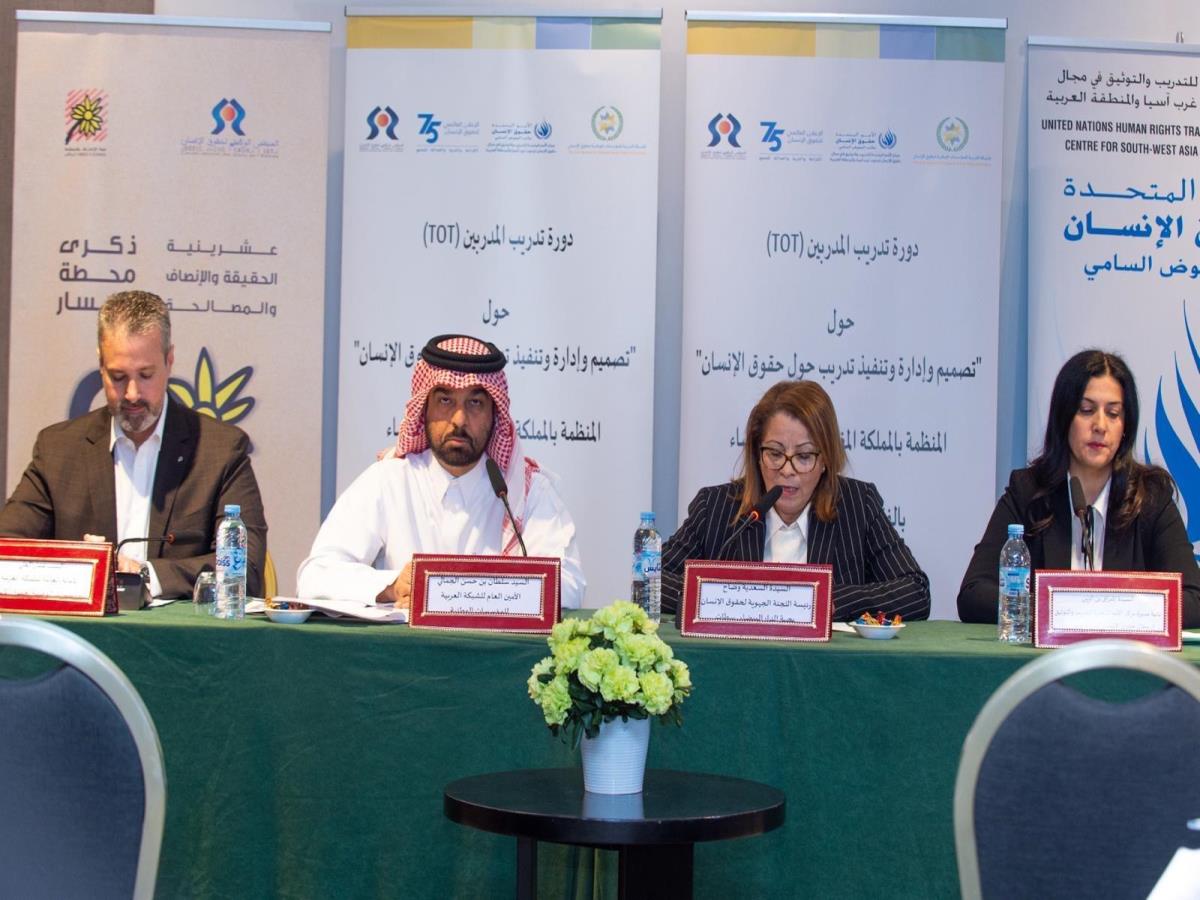
The Arab Network for National Human Rights Institutions continues its efforts to enhance and build the capacities of members of national human rights institutions in the Arab region. The network, in cooperation with the United Nations Training and Documentation Center and the National Human Rights Council in Morocco, is organizing a Training of Trainers program in the field of human rights for the benefit of members of national human rights institutions that are members of the Arab Network. This program will take place in Casablanca, Morocco, from March 4th to 7th.
The Training of Trainers program, which focuses on designing, managing, and delivering training in the field of human rights, aims to develop participants’ knowledge and skills regarding training methodology in the field of human rights.
Mr. Sultan bin Hassan Al-Jamali, the Secretary-General of the Arab Network for National Human Rights Institutions, explained that this is the fifth edition of the program organized by the Arab Network to implement this program at the regional level. He highlighted the importance of training trainers in enabling member institutions to implement their training and educational programs within the institution and at the national level, thereby contributing to achieving their goals of promoting and protecting human rights in their countries.
He stated that a well-designed and effectively implemented human rights training program contributes to empowering rights-holders, enhancing the capacity of duty-bearers to protect human rights, and enabling professionals to fulfil their responsibilities in accordance with human rights standards.
The Secretary-General of the Arab Network for Human Rights Training in the program emphasized that “this course aims to empower participants to plan a training program, including analysing the general context, assessing training needs, designing courses, organizing training, and delivering it, including the use of training tools and methods, refining skills in presenting material, dealing with the target audience, as well as follow-up activities and impact assessment, as well as sharing experiences and best practices among trainees, enhancing your abilities and experience in the field of training preparation and capacity building.”
Al-Jamali noted that the network will work to transition to the national level in organizing and implementing the Training of Trainers program, to include a wider range of the national institution’s staff and some national stakeholders, to benefit from the capacities of the national human rights institutions that the Arab Network has qualified in this field, whether during this course or its previous programs. This will be done with the support of experts from the Arab Network and the experts from the Office of the High Commissioner for Human Rights, by developing training programs on a number of priority human rights topics for member institutions. This allows activating the role of training and programs in building and enhancing capacities and raising awareness of human rights and changing attitudes and behaviours to achieve belief in rights by the staff responsible for their protection, which contributes to its direct reflection on the human rights situation in your countries, continuing this journey with you in enhancing the capacity of future generations to defend human dignity.
He added: “I hope that this course will contribute to enhancing skills in training by closely familiarizing with the methodology of the United Nations High Commissioner for Human Rights, which will contribute to acquiring new and effective training methods, through knowledge of modern and innovative training tools and methodologies.”
For her part, Mrs. Al-Saadiyah Wadah, President of the Regional Human Rights Committee in Casablanca, Morocco, said that this program is taking place in a difficult and complex regional and international context, witnessing escalating crises and serious human rights violations. We believed that they ended with the end of World War II, but we are experiencing a humanitarian catastrophe, with premeditated and deliberate killing daily for about six months, added to it, days of starving children, women, and men in Gaza. We feel helpless, but our human rights conviction resists, so as not to lose hope in a system that has been built with commitment and effort for more than 75 years.
She added: we as the Arab Network for National Human Rights Institutions strongly condemns the killings and forced displacement occurring in Gaza. The network renews its absolute solidarity with its colleagues in the Palestinian Independent Commission for Human Rights, both its staff and members. They call for the awakening of the international community’s conscience to immediately stop the killings and starvation that Palestinians endure daily.
In the context of the training program, Mrs. Wadah emphasized that these training courses always serve as a space for exchanging experiences and knowledge, as well as enhancing cooperation between national human rights institutions. The goal of training trainers is to improve and develop the capacities of staff in member national human rights institutions affiliated with the Arab Network. This enables them to transfer this knowledge and practices to various effective national entities, thereby enhancing protection efforts and promoting human rights.
Ms. Ishraq Al-Zain, Deputy Director of the United Nations Office for Training and Documentation in the Field of Human Rights for Southwest Asia and the Arab Region, stated, “Our role at the United Nations Office is to enhance the capacities and competencies of national human rights institutions, considering them active and effective partners in protecting human rights. We also collaborate in this regard with countries, governments, and all stakeholders.” She pointed out that organizing this training course on training trainers in designing, managing, and implementing human rights training is based on the methodology of the UN High Commissioner for Human Rights for training in the field of human rights.