Login
Signup
News
Organized by the Arab Network and the Association for the Prevention of Torture… an electronic symposium on monitoring areas where there is deprivation of the “do no harm” principle
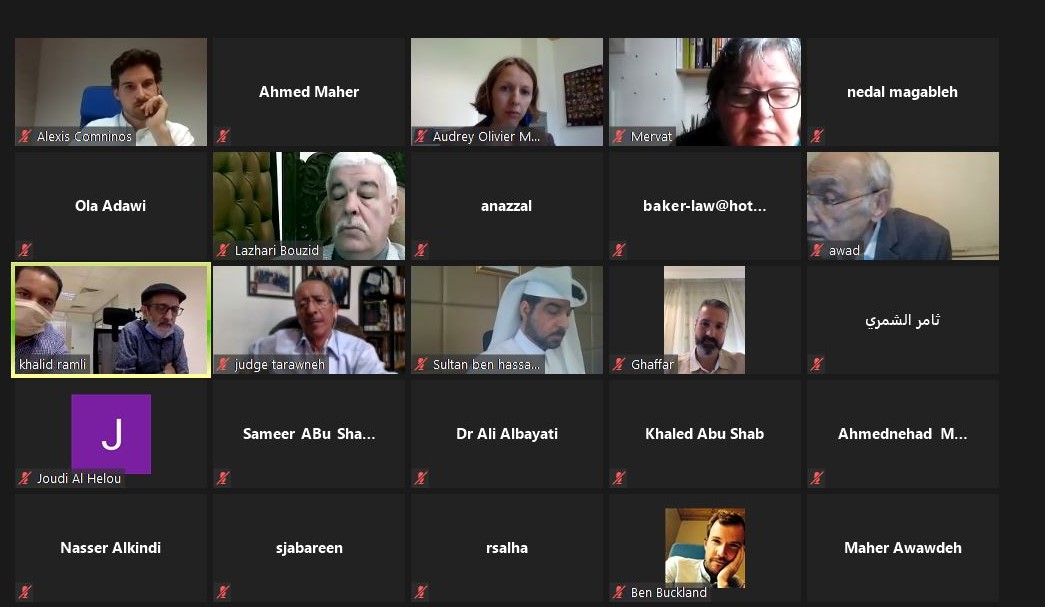
Yunus: The Corona pandemic dictates that national institutions work hard to protect human rights
Al-Jammali: An absolute necessity to exchange experiences and expertise in health crises
The Arab Network for National Human Rights Institutions (ANNHRIs) – based in Doha – in partnership with the Association for the Prevention of Torture APT – based in Geneva – organized an electronic symposium on monitoring areas where there is deprivation of the “do no harm” principle, from theory to implementation.
33 representatives of NHRIs members of the Arabic Network participated in the symposium which aimed to identify the main challenges and good practices related to preventing and countering the spread of the Covid-19 virus in areas of deprivation of liberty. It also aimed to provide practical guidance to detention observers on effective precautionary measures and health considerations that NHRIs and national preventive mechanisms should take while visiting places of detention. Moreover, the symposium explored how the precautionary measures and health considerations of the observers affect the purpose and methodology of monitoring.
In his opening speech, Mr. Issam Younis, Head of the ANNHRIs, Commissioner-General of the Independent Commission for Human Rights in Palestine said that the exceptional circumstances witnessed by the world due to the spread of the Corona pandemic dictate that the NHRIs need to work hard to guarantee and protect human rights. He further noted that an effective role for national institutions is now needed more than ever. Yunus pointed out that the Corona crisis demonstrated the ability of national institutions to work with innovative mechanisms to complete their work, especially monitoring areas of detention, including those of quarantine. He further added in this context that the Palestinian Authority has followed up the conditions of areas of detention and worked to improve them without having to make any field visits to these areas except in cases described as exceptional. He also said that these cases required taking all precautionary and preventive measures against the disease for fear of transmission to inmates and to preserve the health of the employees of the Commission as well . He stressed at the same time on the importance of accessing and exchanging international experiences in this context, and identifying and benefiting from the practical experience of the APT in the work of NHRIs.
For his part, Sultan bin Hassan Al Jammali, Executive Director of the Arab Network, Assistant Secretary-General of the NHRC-Qatar welcomed the participants and thanked the organizers of the symposium. He stressed in a press statement following the symposium on the importance of exchanging experiences and expertise between NHRIs in health crises because of their prominent role in the process of protecting and promoting the right to health and following up on precautions taken and the resulting exceptions in restricting some freedoms within the framework of limiting the spread of epidemics. Al-Jammali further expressed his hope that the participants in the symposium would come out with the best practices and transfer them to their institutions to achieve maximum benefit, according to their mandate during the monitoring and follow-up of cases of epidemics.
For her part, Mrs. Audrey Olivier Moralt, representative of the Association for the Prevention of Torture, gave an overview of the goals of the symposium, and the most prominent activities and events implemented by the Association during the Corona pandemic. Olivier stressed that the pandemic has forced the supervisory bodies to follow a different method of thinking in order to continue to fulfil their obligations in alternative and innovative ways in a manner that respects the “do no harm” principle. In turn, Mr. Alexis Comenos of the Association for the Prevention of Torture reviewed the guidance memo on the Association’s monitoring methodology. He also moderated the dialogue and intervention systems.
The agenda of the symposium dealt with an overview of the results of the webinars. Participants discussed observance of areas of detention under the Covid-19 virus: evaluation of accountability and promising practices. During discussing this topic, participants’ experiences were exchanged. Furthermore, the workshop agenda included guiding questions about specific challenges facing the implementation of the observance mission in the context of the national institutions carrying out their duties in the process of promoting human rights in correctional and penal institutions, and in places where there is deprivation of other liberties under the spread of the Corona pandemic. In addition, participants exchanged best practices through alternative methods of conducting remote observance activities without the need to visit places of detention. This is in addition to methods to apply the “do no harm” principle in practice (including the use of personal protective equipment) in case it is necessary for make a field visit. They also discussed questions of the most important issues identified by the national institutions as being of particular concern.
Participants from Morocco, Algeria, Egypt, Iraq, Palestine, Jordan and Oman reviewed the experiences of their national institutions in the field of observance of places of detention and quarantine and reviewed mechanisms used to achieve this. They also reviewed the best practices that should be taken during their cooperation with the competent authorities on solving the problem of overcrowding in detention centres, and the risks that would threaten detainees. They related their success stories in persuading the authorities to temporarily and exceptionally release some detainees who are not dangerous to society, and to prioritize health and safety considerations according to legal standards and procedures aimed at preserving human dignity and life.
In the same context, the symposium’s concept paper clarified that the epidemiological situation imposed by the spread of the Covid 19 pandemic in most parts of the world, compels observing bodies to think differently in order to continue to fulfil their mandate in alternative ways, while respecting the “so no harm” principle. The paper indicated that NHRIs and national preventive mechanisms could be transformed into a factor for transmitting the disease from outside to areas of deprivation of liberty, thereby posing a threat by transmitting the infection to detained persons as well as to detention personnel. Likewise, the NHRIs and national preventive mechanisms have the duty of care towards its employees, which requires adequate precautions to avoid exposing them to unnecessary or excessive risks.
It is noteworthy that the APT shares its practical experience and vision about monitoring areas of detention while facing the Covid-19 virus, with the aim of providing a platform for Arab national institutions to exchange practices and challenges and to explore practical solutions to help observers adapt their practices in detention. The APT is an independent non-governmental organization headquartered in Geneva. It was founded in 1977 and has directly contributed to the development of international and regional agreements on the prevention of torture, in particular the Optional Protocol to the Convention against Torture. The APT has, therefore, extensive experience in establishing national mechanisms to prevent torture, which will encourage NHRIs members of the Arab Network to raise and strengthen cooperation and exchange information, studies, best experiences, practices and experiences with the organization.