Login
Signup
News
Arab Network Organizes Webinar Entitled “75 years… Developing Human Rights System… Implications and Prospects” in Partnership with High Commissioner for Human Rights, Represented by UN Center for Training and Documentation in Human Rights field for South and West Asia and the Arab Region
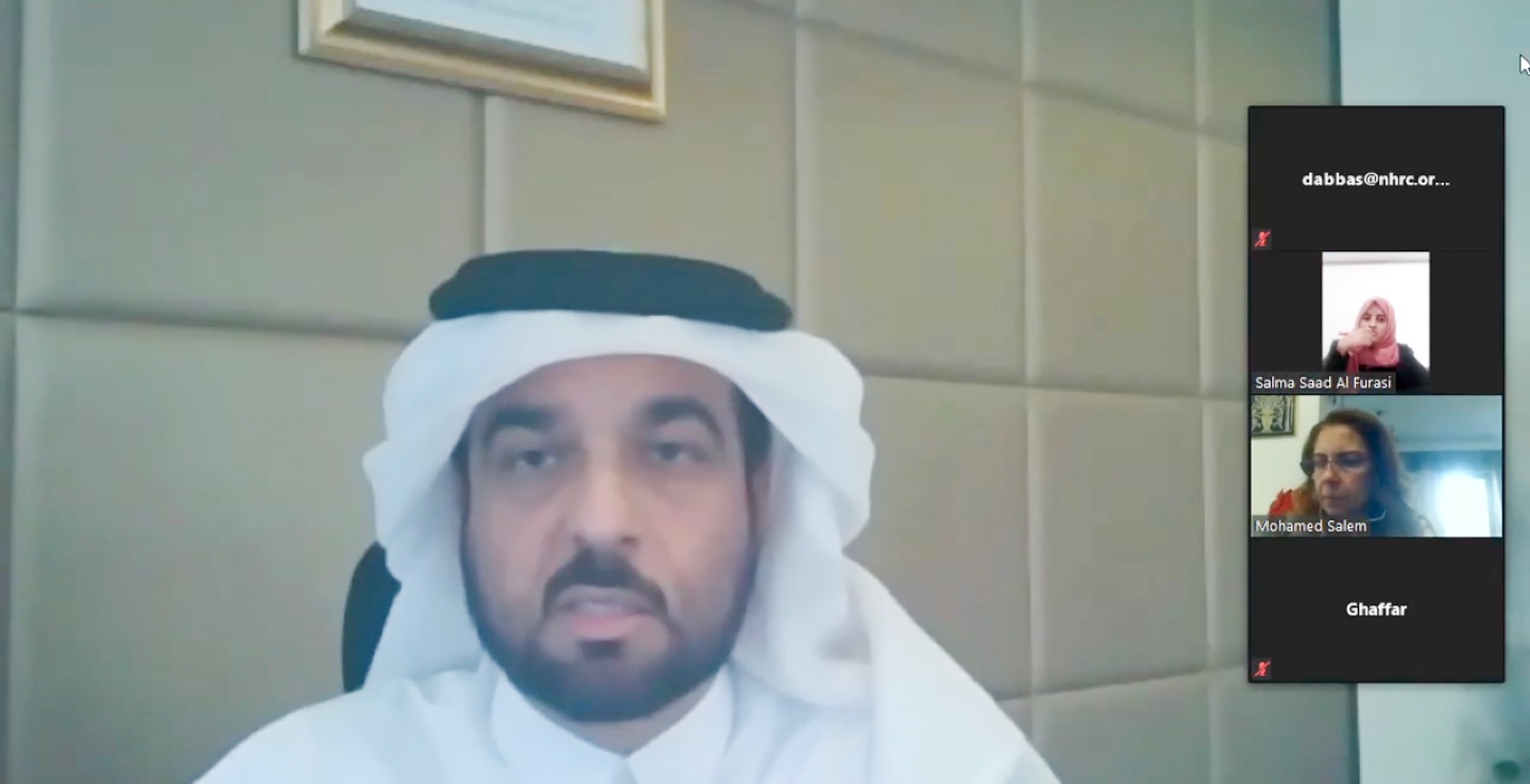
Al- Jammali: SDG 16 “Peace, justice and strong institutions” is central to and on the top of the SDGs.
Participation of developing countries in global governance institutions is required to be enhanced.
It is imperative to invoke international law and establish new tools, methods, and mechanisms to enable the UN to implement its decisions.
The United Nations succeeded in avoiding the outbreak of a World War III.
Doha: 22-10-2020
“In order to undermine the use of force and imposition of the status quo, give priority to public interest and effective and constructive international cooperation to achieve international peace and security,” said Mr. Sultan bin Hassan Al- Jamali, Executive Director of the ANNHRIs based in Doha, “it is necessary to invoke the international law and establish new tools, methods and mechanisms to enable the UN to implement its decisions.” In the same regard, he emphasized the need to end the suffering of the Palestinian Arab people, resolve Palestinian question in accordance with international legitimacy resolutions, end Israeli occupation, establish State of Palestine with Jerusalem as its capital, and establish just and comprehensive peace according to the principle “land for peace”.
This statement was delivered during a webinar organized today by the Arab Network entitled “75 years … Developing Human Rights System. Implications and Prospects”. It was in partnership with High Commissioner for Human Rights, represented by the UN Centre for Training and Documentation in Human Rights for South and West Asia and the Arab Region. Additionally, it was attended by 75 participants from 20 Arab countries representing national human rights institutions that are members of the ANNHRIs as well as a number of civil society organizations and human rights activists.
Furthermore, the Executive Director of the ANNHRIs emphasized the necessity to implement the goals of the 2030 Agenda for SDGs. He pointed out that in the event of implementing this plan, it will form the basis of solutions. “Implementation of the SDGs requires serious, honest and effective international solidarity between countries and all stakeholders,” said Al-Jammali. He also pointed to the vision that the ANNHRIs joined with regard to Goal 16: “Promote peaceful and inclusive societies…”. Due to its major role in creating the sincere will of countries and their governments to work on the SDGs, the Goal 16 is the key and focus of the implementation of the 2030 SD plan. At the same time, the Executive Director stated that protection from crime and violence and presence of honest and responsive governments are among the top priorities of development. Peace, justice, and effective governance are development results in themselves, not just inputs or factors helping in development. “Therefore”, Al-Jamali said, “we in the ANNHRIs consider Goal 16: “Peace, justice, and strong institutions” a central to and on the top of the SDGs, through which the other goals can be achieved. This is through effective and governed government departments.” Furthermore, he indicated that the SDGs seek to significantly prevent all forms of violence, work with governments and communities to find lasting solutions to conflict and insecurity. Moreover, he said that strengthening the rule of law and promoting human rights are essential in this process. Al-Jamali further called for the importance of enhancing the participation of developing countries in global governance institutions and the implementation of the principle “leaving no one behind”.
Al-Jammali congratulated on the 75th anniversary of founding the UN, pointing out that the UN, during these previous years, succeeded in avoiding the outbreak of a world war III. This is in addition to its appreciated and commendable efforts to promote and protect human rights. “On this occasion,” Al-Jamali said, “we extend our congratulations on the states’ declaration to renew their commitment to the UN Charter and its objectives. We further support all the points made in the speech of the UN Secretary-General on the occasion of the 75th anniversary of funding the UN as well as presented challenges and solutions. We also support the declaration of the 75thanniversary of founding of the international organization, endorsed by all 193 member states of the UN General Assembly.” Furthermore, Al-Jamali indicated that cooperation of ANNHRIs will continue with the UN teams, agencies, councils, and commissions as well as the UN treaty and non-treaty mechanisms. He stated that Arab Network believes in the unity and universality of the human rights course, washing further strengthened and protected rights for the whole world and the Arab region, in particular.
For his part, Deputy Director of the UN Centre for Training and Documentation, Mr. Alaa Kaoud submitted a working paper. In this paper, he discussed main milestones that the international human rights system has gone through since the inception of the UN, extent of interaction with the work of these mechanisms in terms of promoting and protecting human rights, including work on developing standards and guarantees. Kaoud further touched on major milestones in the development of the human rights system, starting from a central body concerned with human rights in the United Nations to the UN’s struggle against racism and development in terms of the human rights: “Rights of Persons with Disabilities Model”. At the end of the working paper, Kaoud stated some recent initiatives that are in progress and concerned with providing further guarantees for the promotion and protection of human rights within the UN human rights system.
During the webinar, there were interventions by the participants. These interventions focused on the UN’s role in combating racism and decolonization, the importance of the mechanisms and the role of national institutions to encourage their countries to ratify them. This is in addition to the importance of working on the 2030 SD Agenda to eliminate corruption as a first step and importance of introducing and training on human rights at an early age. There was also a focus on the Arab human rights system and the establishment of permanent Arab Committee on Human Rights and its role. Furthermore, Kaoud commended cooperation with the ANNHRIs to promote human rights in the Arab region. Furthermore, other interventions related to the issues of the international human rights system were made.