Login
Signup
News
ANNHRI Organizes Consultative Meeting in Cooperation with AIHR to Re-imagine the Future of Education by 2050
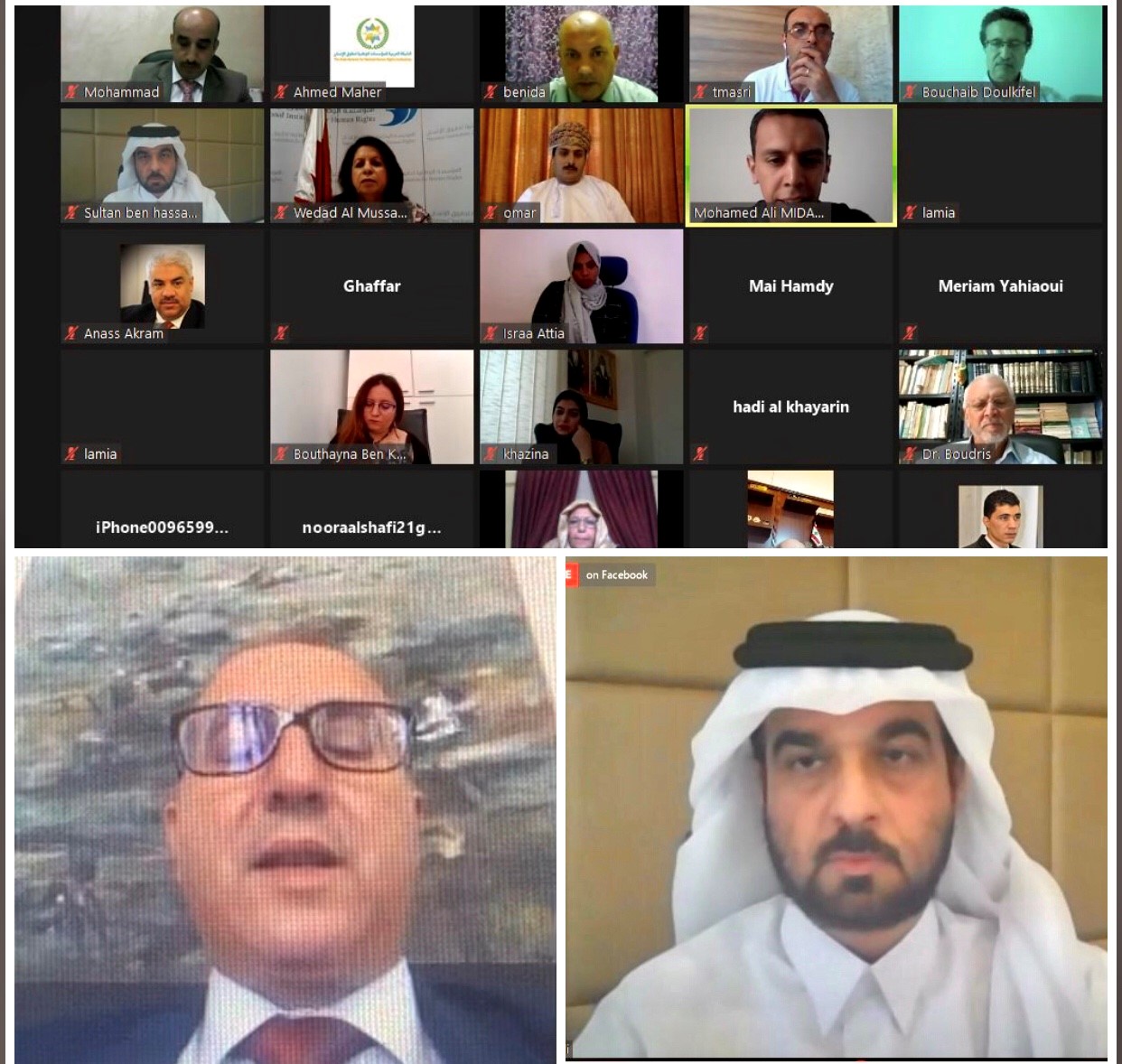
National Institutions in the Arab Region provide UNESCO with their Recommendations.
Al Jammali: we must re-consider of building and rehabilitation of the teacher and secure a dignified life to him.
Remove hate speech from the curriculum in the Arab region wherever it exists and replace it with the values of tolerance
An important role for schools in the process of building students educationally, scientifically, and psychologically
Abdul Basit: Education has always had a strong presence in communities reformation.
National institutions for human rights are the essence of the vision for educational reform.
We perceive education is an integral tool for leading the values of freedom, equality, and justice.
Doha on 30th of June 2020
Mr. Sultan bin Hassan Al Jammali, Executive Director of the Arab Network for National Human Rights Institutions (ANNHRI), headquartered in Doha, stressed the prominent role of schools in student building process in terms of education, science, and psychology, especially at the primary education stage. He noted that teachers and curricula are the two cornerstones in student building process, which he described as a national project.
This was a part of Mr. Al Jammali’s opening speech at the consultative meeting on “The Future of Education in the Arab Region’, which was remotely organized by the Arab Network for National Human Rights Institutions (ANNHRI) and the Arab Institute for Human Rights (AIHR), headquartered in Tunisia. Al-Jamali elaborated saying that teachers are nation builders and developers of future generations. Therefore, we have to reconsider the process of teacher building and qualification. A teacher should have a decent life for himself and his family so that he can play his educating role as required. Learning environment, methods and tools have to be improved and developed in line with current science development. He added that educational curricula in the Arab region should be reviewed so that hate speech would be erased and replaced with values of tolerance, acceptance of others, coexistence, amity and brotherhood. They should include principles and culture of human rights, which would facilitate educating generations and raising their awareness regarding their human rights, as well as training them to claim, promote and protect these rights. Additionally, these reviewed curricula should train generation on how to make dialogues as a method of problem solving, as well as to reject violence, accept differences and other’s opinions.
Al-Jamali affirmed that the culture of human rights draws its power from individual conscious understanding of such culture which would be manifested in people respecting the culture of human rights. In this context, he called for the urgency to upgrade stages of compulsory education to include secondary stage and empower next generation to confront challengers and rapid changes of the age. “We look forward to conclude this significant meeting with recommendations that would contribute to the formation of a picture of the future of education by 2050 and we wish that the ANNHRI and National Institutions for Human rights would continue their collaboration with the AIHR, UNESCO and all stakeholders to invest in education”, he added.
On his part, Mr. Abdul Basit Bin Hassan, President of the AIHR, stated that the education issue is a universally comprehensive matter that the United Nations and UNESCO have always been endeavoring to find methods for its development and improvement throughout various eras, especially during the exceptional circumstances the world is currently experiencing. Bin Hassan introduced the International Commission on the Future of Education, stating that it consists of 18 male and female experts from all over the word and that it is chaired by H.E. Ms. Sahle-Work Zewde, President of the Federal Democratic Republic of Ethiopia. He explained that the Commission’s main assignment is to lead a multi-voiced dialogue, which is a global conversation that aims at searching for methods to foresee the future of education by 2050. He added that the Commission will not limit education to schools only, rather it will work on a number of issues related to education, such as education during wars and conflicts, relationship of education to integration, discrimination issues and its relationship to the environment and modern technology, as well as a number of education-related issues. He noted that the Commission considers education as the foundation for finding solutions for world crises and exploring ways to elevate nations.
Bin Hassan elaborated saying that education is open to all communities. It is perceived as shared wealth, public interest and an integral tool used for establishing the values of freedom, equality and justice. He stressed in the same context that education is a key instrument in the development of our integrated and sustainable communities. He explained that education is the answer to all problems of our world today, such as violence, poverty, growing gap between peoples, individuals and communities, in addition to current complaints related to loss of overall environmental, economic, social and other balances. Bin Hassan pointed out that national institutions for human rights are the essence of the vision for educational reform. He noted that the ANNHRI and AIHR are united by a partnership that has been manifested on several occasions. He stated that both sides are concerned with exploring methods to develop issues of human rights education and culture dissemination. “The ANNHRI has always been a good supporter to us at the AIHR when it comes to defending human rights and finding solutions for the reformation of the affairs of our communities, despite difficulties and complications related to this type of reformation. Education has always had a strong presence every time we discussed the issue of reformation, as education is and will always be a foundation for communities revival and sustainable development building.”, he added.
It should be mentioned that, in July 2019, UNESCO launched a global initiative to establish a high-level international commission to re-imagine the future of education by the year 2050. The International Commission on the Future of Education is composed of a group of prominent experts and opinion makers from various areas of politics, business, arts, humanities and civil society. Their mission is to collectively think about how education might need to be reconsidered an increasingly complex world and provide solutions and recommendations formulated in a major report that would serve as an agenda for policy dialogue and action at multiple levels.
The consultative meeting discussed the most important challenges and problems that face education, in addition to perceptions and proposals for education development in the future. Moreover, the meeting focused on main themes that handled the process of rethinking the concept and measures of development and improvement, formulation of new visions of education in multiple facts besides knowledge as an international public interest, redefinition of frameworks of education and adoption of a humanitarian approach to education and development. Additionally, the meeting explained the UNESCO’s international initiative and the high-level International Commission on the Future of Education by 2050. During the meeting, male and female representatives of national human rights institutions in the Arab region made speeches that presented the realities and problems of education in their countries respectively. Each one of these representatives provided recommendations for the future of education by 2050. The consultative meeting was concluded by presenting general recommendations from the UNESCO to be included in the global conversation of the high-level International Commission on the Future of Education