Login
Signup
News
His Excellency Mr. Sultan bin Hassan Al-Jamali, Secretary-General of the Arab Network for National Human Rights Institutions, met with His Excellency Dr. Rashid bin Hamad Al-Balushi, Chairman of the Omani Human Rights Committee
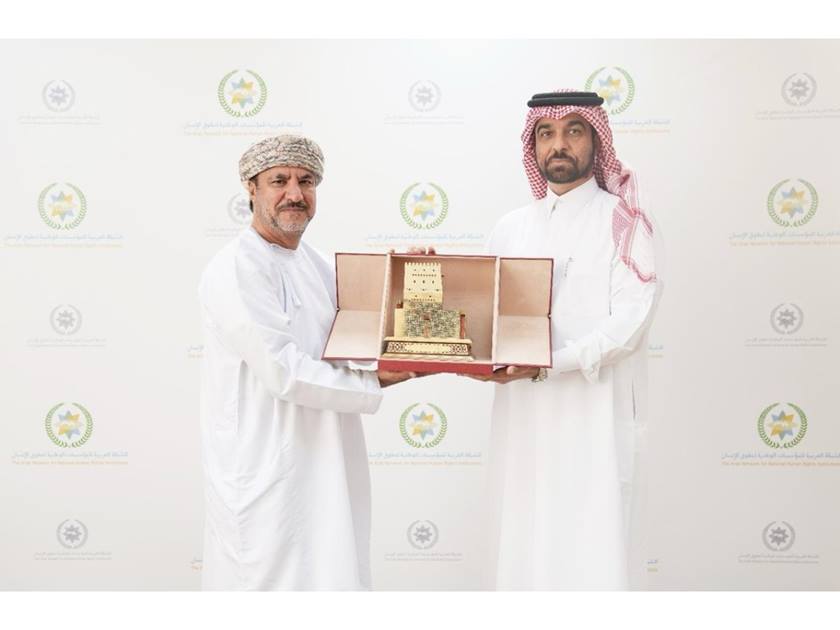
The Arab Network for National Human Rights Institutions, headquartered in Doha, and the Omani Human Rights Committee announced the organization of an international conference in the Sultanate of Oman on current regional and international human rights issues, scheduled for July.
This announcement came during a meeting between His Excellency Mr. Sultan bin Hassan Al-Jamali, Secretary-General of the Arab Network, at the network’s headquarters, and His Excellency Dr. Rashid bin Hamad Al-Balushi, Chairman of the Omani Human Rights Committee, and his accompanying delegation, as part of discussions on ways to collaborate and benefit from the training programs organized by the network for national committees.
Al-Jamali stated that the meeting discussed means to enhance mechanisms for exchanging experiences and best practices to develop national committees and strengthen their efforts to obtain accreditation from the Global Alliance of National Human Rights Institutions. The meeting also explored leveraging the expertise of legal advisors in this regard, and reviewing the developments and progress made by the Omani Human Rights Committee within the framework of the Paris Principles.
Regarding training needs, it was noted that the meeting discussed the possibility of holding training workshops in Oman and benefiting from the network’s staff experience. This is in line with the network’s mission to defend human beings, preserve their dignity and rights, by supporting Arab national human rights institutions and enabling them to understand their roles in achieving their goals by enhancing their capabilities.
He added that a study is underway for a training program according to the urgent needs of the Omani Human Rights Committee, within the context of implementing its programs and plans. This is part of the Arab Network’s work to achieve the goals of its strategic plan and operational plan, for independent training at the national level. He emphasized the necessity of enhancing the capabilities of members of Arab national human rights institutions to enable them to carry out their roles and tasks professionally and skilfully to achieve the best results.
He confirmed that the training programs are part of the network’s participation in supporting the implementation of part of the programs of member institutions at the national level during the current year and the coming years. The aim is to build and enhance capacities in various fields of the work of national institutions, to enable them to carry out their tasks optimally, as well as to promote a culture of human rights through seminars, dialogue workshops, conferences, and awareness programs.
He stressed the need to deepen understanding of the nature and role of national human rights institutions, their independence standards, tools for cooperation and integration with national and international stakeholders, and the accreditation process before the Sub-Committee on Accreditation to obtain “A” classification. This focus aligns with the Global Alliance of National Human Rights Institutions and its Sub-Committee on Accreditation.
The Secretary-General of the Arab Network for National Human Rights Institutions pointed out that the network’s efforts to strengthen and support Arab national human rights institutions and assist them in obtaining “A” accreditation from the Sub-Committee on Accreditation of the Global Alliance of National Human Rights Institutions are based on the belief in the positive impact on the reality of these institutions and their ability to enhance and protect human rights in their countries. This enables the network to continue advancing towards its goal of promoting and protecting human rights in the Arab world.
He emphasized the importance of integration and cooperation between national and international stakeholders and civil society organizations, as well as deepening understanding of the Paris Principles, stressing that this is necessary to increase the effectiveness of the impact of national human rights institutions at the local level.
Al-Jamali pointed out the Arab Network for National Human Rights Institutions’ direction to intensify its activities during the current year and the coming years with member institutions at the national level. The aim is to raise awareness and educate about human rights, training on receiving and following up on complaints, visiting places of detention, monitoring, investigating, reporting, and advocating, as well as preparing reports and interacting with international human rights mechanisms.
Dr. Rashid bin Hamad Al-Balushi, Chairman of the Omani Human Rights Committee, praised the Arab Network’s role in strengthening national human rights institutions in terms of their global classification and capacity building for their members. He affirmed the Arab Network’s and the Omani Committee’s keenness to enhance cooperation and build partnerships between them in the future. He also emphasized the Omani Committee’s keenness to benefit from the experiences of Arab national committees with distinguished international classification, through cooperation with the network.