Login
Signup
News
ANNHRI organizes in Cairo the course of Muhammad Fayek (3)
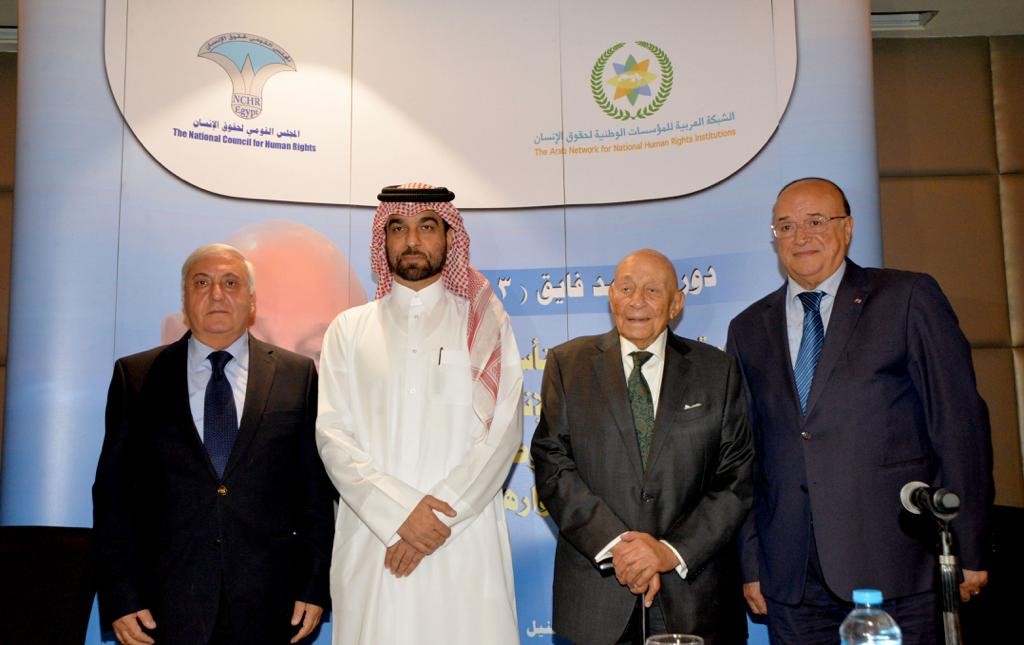
Al-Jammali: Our mission is to protect human dignity
Karem: National institutions depend on the international community to urge states to protect human rights
Fayed: The course comes to prepare a new generation to move forward in the process of spreading the culture of human rights
Fayek: The success of the State of Qatar in hosting the World Cup eliminates the inferior view that the West holds of the Arab countries
Cairo: 22 December 2022
The Arab Network for National Human Rights Institutions Activities & Events organized Mohamed Fayek’s (3) foundational training course on “The Human Rights System and the Establishment and Roles of National Human Rights Institutions”. The course, which was held in the Egyptian capital, Cairo, from the 20 – 22 of December, 2022, aimed at introducing new members of national institutions to the international human rights system, the basic principles and concepts of human rights, their origins and
development, international human rights law and international humanitarian law, contractual and noncontractual human rights mechanisms. The course also addressed the universal periodic review mechanism, in addition to the emergence and role of national institutions in accordance with the Paris Principles and the development of relevant skills for new workers in the field of human rights from the civil society organizations and national institutions members of the Arab Network.
In his opening speech, His Excellency Mr. Sultan bin Hassan Al-Jammali, Secretary-General of ANNHRI, emphasized the network’s mission to protect human dignity, and said: “It was Fayek’s obsession and message during his human rights career,” and added: “This lofty message is the reason and goal behind all our efforts to combat violations and promote and protect rights.” He pointed out that there
is no taste for life without dignity, and said: “We do not accept any form of enslavement, so we will spare no effort in defending human dignity and enhancing the self-worth of individuals and their pride in themselves.”
In the same context, Al-Jammali called for the necessity of organizing and framing the Arab Network’s adoption of the cause of our Arab people in Palestine, praising at the same time the position he described as honorable for the Arab people from the ocean to the Gulf without exception
regarding the cause of their people in Palestine and their position on the racist Israeli-Zionist occupation – the popular position that appeared clearly during the Qatar World Cup 2022. “This position,” he added, “was clear in the global popular for the Palestinian cause through the behavior of a number of fan groups from different European and Ibero-American countries as well as from Africa and Asia.” He said: “This international position on the Palestinian cause indicates the correctness of the path and that the right whose people do not despair of claiming will find someone to support it.” Mr. Al-Jammali reiterated the recommendation of the need to advocate for human rights causes in general, and towards the cause of the Palestinian Arab people in particular. He called for supporting them in order to lift the injustice and racial persecution that are practiced on them by the Israeli occupation, and to oppose colonial ideas and racial discrimination that establish immoral rule of the world along with what it entails of enslavement of peoples under new names, methods and tools.
For his part, His Excellency Ambassador Mahmoud Karem, Vice-President of the Egyptian National Council for Human Rights, said: “The decision to organize an annual course bearing the name of Minister Mohamed Fayek is in appreciation of His Excellency for his efforts in the service of human rights.” He added that there is no doubt that national human rights institutions and civil society organizations are
the entities that the international community relies on to urge States to promote and protect human rights in their countries through their interaction and cooperation with international human rights mechanisms, and encourage them to implement and follow up the implementation of the recommendations of contractual and non-contractual mechanisms. He also stressed the need to pay attention to increasing training for cadres working in all entities concerned with protecting and promoting the dissemination of a culture of human rights, in accordance with the latest studies and practices and based on international conventions and mechanisms.
His Excellency Ambassador Fahmy Fayed, Secretary General of the Egyptian National Council for Human Rights, affirmed: “This course comes to place a newly appointed generation of the Arab national institutions and civil society organizations at the beginning of the road to move forward with the
process of spreading the culture of human rights and protecting and respecting human dignity in our Arab countries and the world at large. He pointed out that working to support institutional and technical capabilities and building a culture that supports human rights and awareness comes at the top of the priorities of the National Council’s work, noting that the Council has developed an action plan to implement a number of training programs and workshops to raise the capabilities and competence of its affiliates and make use of best practices and successful experiences in the concerned authorities in the country and national and international institutions, in cooperation with the Arab and African networks and the Office of the High Commissioner for Human Rights. Fayed said: “This training comes as part of
the National Council’s action plan, as it aims to build and refine skills and raise the capabilities of new cadres working in the field of human rights, and to strengthen the capabilities of civil society organizations and national institutions to enable them to carry out their roles and tasks with professionalism and skill to achieve the best results established for them and to reflect all these efforts in practice.
“The Arab Network was able to perform its work efficiently without being affected by the fluctuation of political relations between some Arab countries at certain times because we know that political differences quickly disappear, and that Arabs swiftly return to each other.” He called for the Arab Network to be a role model in Arab commercial, cultural, scientific and other relations that must continue without being interrupted by fluctuations in political relations. Fayek pointed out that the Arab Network is a national organization for the benefit of all Arab countries, and every national institution that is a member of ANNHRI seeks to improve the human rights situation in its country. He added that “We do not interfere in the internal affairs of any other country.
However, as independent institutions, we support each other by exchanging experience and training through this network, and we defend the rights of our peoples.” Fayek further said: “We know very well that full respect for human rights and freedoms has a great impact on strengthening the role of soft powers such as sports and art min all its forms as well as science and scientific research, and that these matters have become one of the measures of the greatness of nations.” He continued by saying: “Therefore, the success of a country like Qatar in hosting the World Cup, the world’s consensus that it is the most beautiful and best World Cup organized so far, and that the Kingdom of Morocco’s team becoming one of the big four in the tournament, are very important things in the field of human rights because they eliminate the inferior view that the West holds of us and our Arab countries. Fayek congratulated the State of Qatar and the Kingdom of Morocco on the success, which is a success for all the Arab nation.
Fayek also thanked the late Professor Boutros-Ghali and thanked His Excellency Dr. Ali Al-Marri, and said that they had a great credit for the establishment of the Arab Network for Human Rights.
It is noteworthy that Mohamed Fayek’s course comes within the framework of building and raising the capabilities of affiliates of national institutions that are members of the Arab Network, civil society cadres and activists, and government cadres working to protect human rights. This course was held in honor of him, and the prominent personalities of the pioneers and leaders of the human rights movement in the Arab world as well, as a human rights activist who had the credit and imprint on the course of this movement in the Arab region.