Login
Signup
News
The Arab Network organizes in the Lebanese capital, Beirut, during the period 7-10 November 2022, a course for receiving and following up complaints, visiting places of detention, and preparing monitoring reports
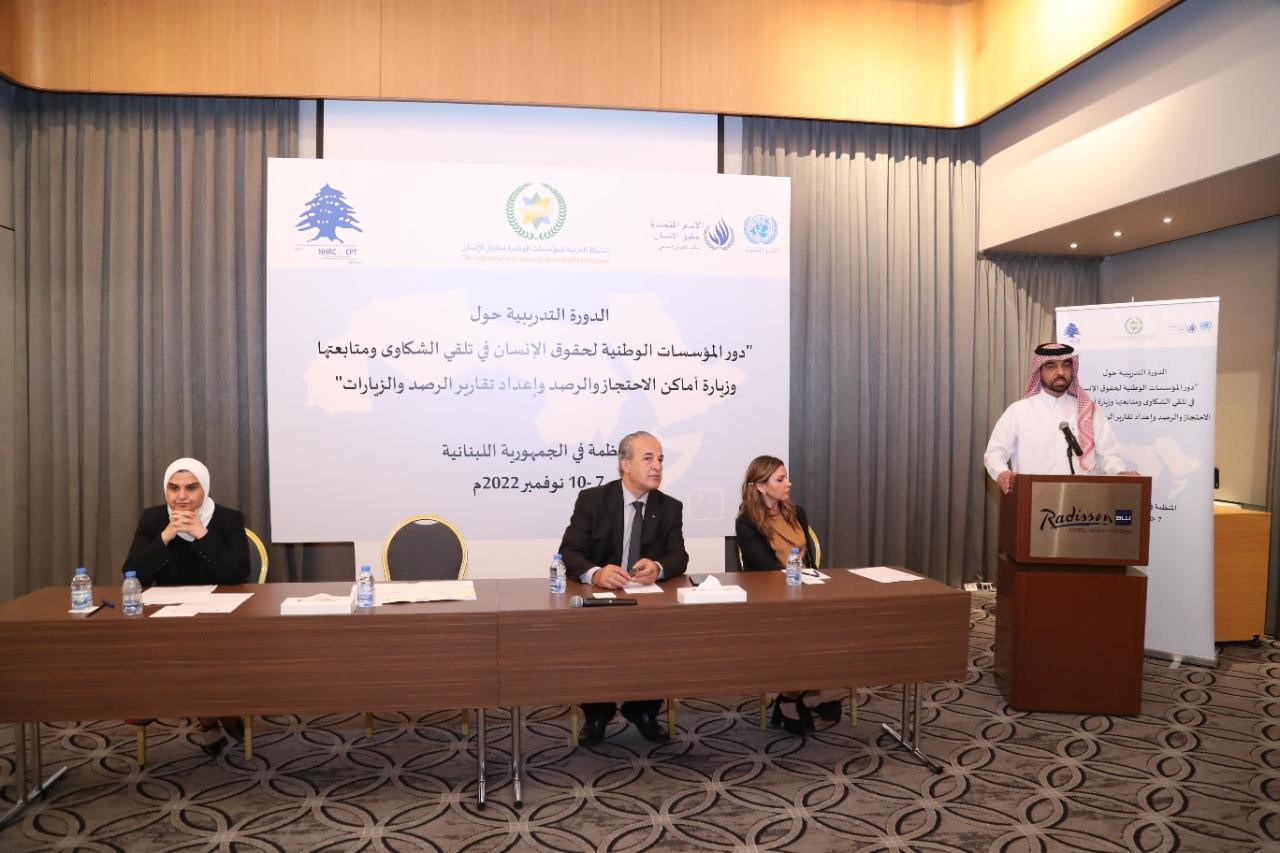
Al-Jammali: Monitoring, visiting places of detention, and receiving complaints are among the core tasks of human rights institutions Gerges: It is particularly important to train trainers and increase their understanding of current human rights issues
Khreisha: National institutions should have the authority to collect information and have monitoring and documentation mechanisms
Beirut: 8 November, 2022
The Arab Network for National Human Rights Institutions in the Lebanese capital, Beirut, organized during the period 7-10 November 2022 a training course on “receiving and following up complaints, visiting places of detention, and preparing monitoring reports” in cooperation with the National Human Rights Commission, including the Committee for the Prevention of Torture in Lebanon and the United Nations Training and Documentation Center In the field of human rights for Southwest Asia and the Arab region.
In his opening speech to the course, His Excellency Mr. Sultan bin Hassan Al-Jammali, Secretary-General of the Arab Network, considered that monitoring operations, visiting places of detention, receiving complaints and following them up, and preparing reports are among the essential and daily tasks of national institutions. He said: “These tasks are in the interest of the public and show their direct impact on the reality of human rights, in a way that enhances confidence in the national institution in the event that it performs its role entrusted thereto according to the Paris Principles of 93 with professionalism and independence, and highlights its role as an office of grievances and a defender of human rights. He stressed the importance of the themes of this course as they strengthen and refine the capabilities of the national institutions in field work, and reflect positively on the role of the national institution in the promotion and protection of human rights.
Al-Jammali indicated that the ANNHRI works independently and with its partners to repeat this course because of its utmost importance, as it is directly related to the tasks of national human rights institutions within the framework of its broad mandate to protect human rights. He added: “This course always targets new cadres in national institutions and sharpen the skills of expert cadres in the institution, by exchanging experiences and best practices between participants from the member institutions of the Arab Network, as well as with their colleagues from the concerned authorities and civil society organizations. Such a course also enhances stakeholders’ knowledge of the role of national human rights institutions in the field of protection, in a way that facilitates their tasks, encourages cooperation with them, and enables them to carry out their tasks.” The Secretary-General of the Arab Network said that, in terms of the result and after completing all these tasks with high professionalism and to achieve the desired goal of promoting and protecting rights, professional reports must be prepared in a way that reflects reality, including proposals and recommendations that make it easier for the authorities to stop violations and promote rights, in addition to developing a plan within each institution to follow up on the impact and acceptance of these recommendations by the concerned authorities. He clarified that plans should be developed to encourage and urge authorities to respond to human rights issues and enhance their desire to cooperate with the National Institution and other stakeholders in this regard, and to contribute to creating an atmosphere of integration to achieve a national situation in which human dignity is enhanced.
AL-Jammali thanked the National Human Rights Commission of Lebanon, represented by its president, His Excellency Dr. Fadi Gerges, for their hospitality and cooperation in organizing the course. He also thanked the Office of the United Nations High Commissioner for Human Rights and the United Nations Center for Training and Documentation for their fruitful cooperation with the Arab Network in the field of raising and building Capacity.
For his part, Dr. Fadi Gerges, president of the National Human Rights Commission, including the Committee for the Prevention of Torture in Lebanon, welcomed the participants and expressed his hope that the training course would witness fruitful works for the good of people in Lebanon, the Arab nation, and humanity as a whole. He said: “This course is of particular importance because it is based on training the trainers on receiving complaints, following them up, visiting places of detention, monitoring and writing reports with the aim of increasing their understanding of one of the most important human rights issues at the national and international levels.”
In the same context, Dr. Abeer Khreisha, Director of the Doha based United Nations Human Rights Training and Documentation Center for South-West Asia and the Arab Region – based in Doha – stressed the keenness of the United Nations High Commissioner for Human Rights to support national human rights institutions in their work. She said: “The Office of the High Commissioner works closely with
national institutions, whether at the national or regional level, in order to protect and promote human rights at all levels, in addition to promoting the effective implementation of international human rights standards at the national level.”
Dr. Khreisha emphasized the necessity for national institutions to have the authority to collect the information and evidence they need to perform this role, in addition to providing mechanisms to enable national institutions to monitor and document.