Login
Signup
News
The Arab Network participates in a regional symposium in Tunisia entitled “The future of education in Arab countries: policies, approaches and solutions”
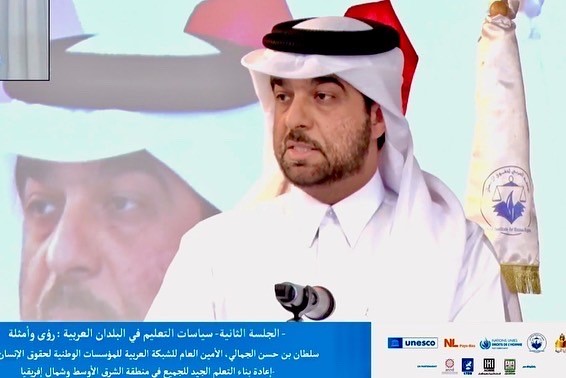
Al Jamali: national human rights institutions have a broad authority to promote and protect human rights in their countries
Tunis: 14 May 2022
On the 13th and 14th of May, the Arab Network of National Human Rights Institutions’ General Secretariat in Tunisia participated in the regional symposium “The Future of Education in Arab Countries: Policies, Approaches, and Solutions”, organized by the Arab Institute for Human Rights in collaboration with the Arab Organization for Human Rights, the Arab Lawyers’ Union, the Tunisian Human Rights League, and the Network of Arab NGOs for Development.
In a working paper on “The role of national human rights institutions in the development of education policies in Arab countries: Visions and Prospects”, presented by H.E. Mr. Sultan bin Hassan Al Jamali, Secretary-General of the Arab Network, Al-Jamali called for cooperation, synergy, and solidarity to bring about the desired change in UNESCO’s education report. And he said: “The recommendations of the Arab Network’s events and conferences have come to confirm this, dedicating and activating the role of national human rights institutions in implementing and following up the implementation of the goals of the 2030 Agenda for sustainable development, including goal 4, by focusing on the realization of goal 16 as the key to the implementation of the goals of the 2030 Agenda for sustainable development. Noting that without peace, justice, strong institutions, transparency, accountability, the fight against corruption and governance, no SDGs can be implemented.
Al Jamali stated that one of the fundamental rights guaranteed by all international and regional conventions and treaties is the right to education, and that national human rights institutions established in accordance with the Paris Principles of 93 have broad authority to promote and protect human rights in their countries. This authority includes all of the rights enshrined in the International Bill of Human Rights, as well as those enshrined in the conventions to which it is a party. Al Jamali stated that NHRIs promote and protect the right to education by advising the government and contributing to the national curriculum review to eliminate hate speech and replace it with tolerance, dialogue, and peace speech. In addition to collaborating with government institutions and civil society to promote a human rights culture, reviewing legislation to ensure compliance with human rights principles and standards outlined in international conventions to which its states are parties, as well as capacity-building and support for educational institutions in incorporating human rights concepts and values into their curricula, policies, and practices, as well as monitoring, preparation, and dissemination of national and international reports, and interaction with treaty bodies to follow up on their recommendations and submit reports on the realities of the rights protected by these treaties.
His Excellency the Secretary-General of the Arab Network stressed the need for political will and resources to complement the work on SDGs 17 and its international solidarity in order to, successfully reach strong institutions that contribute to the implementation of goal 4 on education. Al Jamali invited Arab national human rights institutions that are members of the Arab Network to act on the recommendations of the Network’s conferences in this regard, such as: contributing to the realization of the 2030 Agenda for SDGs by advocating for their integration into national plans and public policies; and expressing opinion and advice to Governments and parliaments in order to review national laws and align them with the goals and objectives of the sustainable development. In addition to emphasizing the importance of the objectives, the principle of unanimity sought to drive states’ compliance and secure the budgets required to achieve the goals. Implementation of treaty body recommendations, special procedures, and the universal periodic review as they relate to the achievement of SDGs. In addition to encouraging stakeholder, engagement and involving marginalized groups such as people with disabilities, youth, and minorities. Strengthen national human rights institutions’ capacity to use human rights indicators and SDGs, as well as assess states’ commitments and efforts to implement SDGs in accordance with human rights standards. In addition to the need for NHRIs to use their reporting mechanisms to include the results of monitoring and the extent to which SDGs are implemented in their reports. And the establishment of a unit or committee within national human rights institutions to monitor the implementation of SDGs. as well as strengthening cooperation among national human rights institutions and establishing international and regional partnerships for the implementation of SDGs. In collaboration with relevant international and regional institutions, the Arab Network of National Human Rights Institutions will continue to strengthen Arab national institutions’ capacity to implement and measure the 2030 Agenda for sustainable development, monitor progress in its implementation, and facilitate the exchange of experiences in this area. National human rights institutions should contribute to the implementation of the SDGs by reviewing the legislative framework to align it with international human rights standards in response to the SDGs, thereby contributing to policy formulation and analysing their responsiveness to the SDGs, monitoring the existence of effective institutions, the nature of their performance, and providing a rigorous monitoring system. Incorporate development goals into NHRI strategies and annual reports, and work with NHRIs to link the complaints database with SDG indicators. In addition to strengthening democracy in their countries through election monitoring, encouraging and pursuing more inclusive elections, addressing violence against women and minorities during the electoral process, and expanding participation to ensure women’s and young people’s participation and access to leadership positions.