Login
Signup
News
The International Solidarity Conference stresses the need for concerted efforts to address the roots and causes of conflicts and to strengthen Arab judicial cooperation to confront terrorism
Cairo, 28 February:
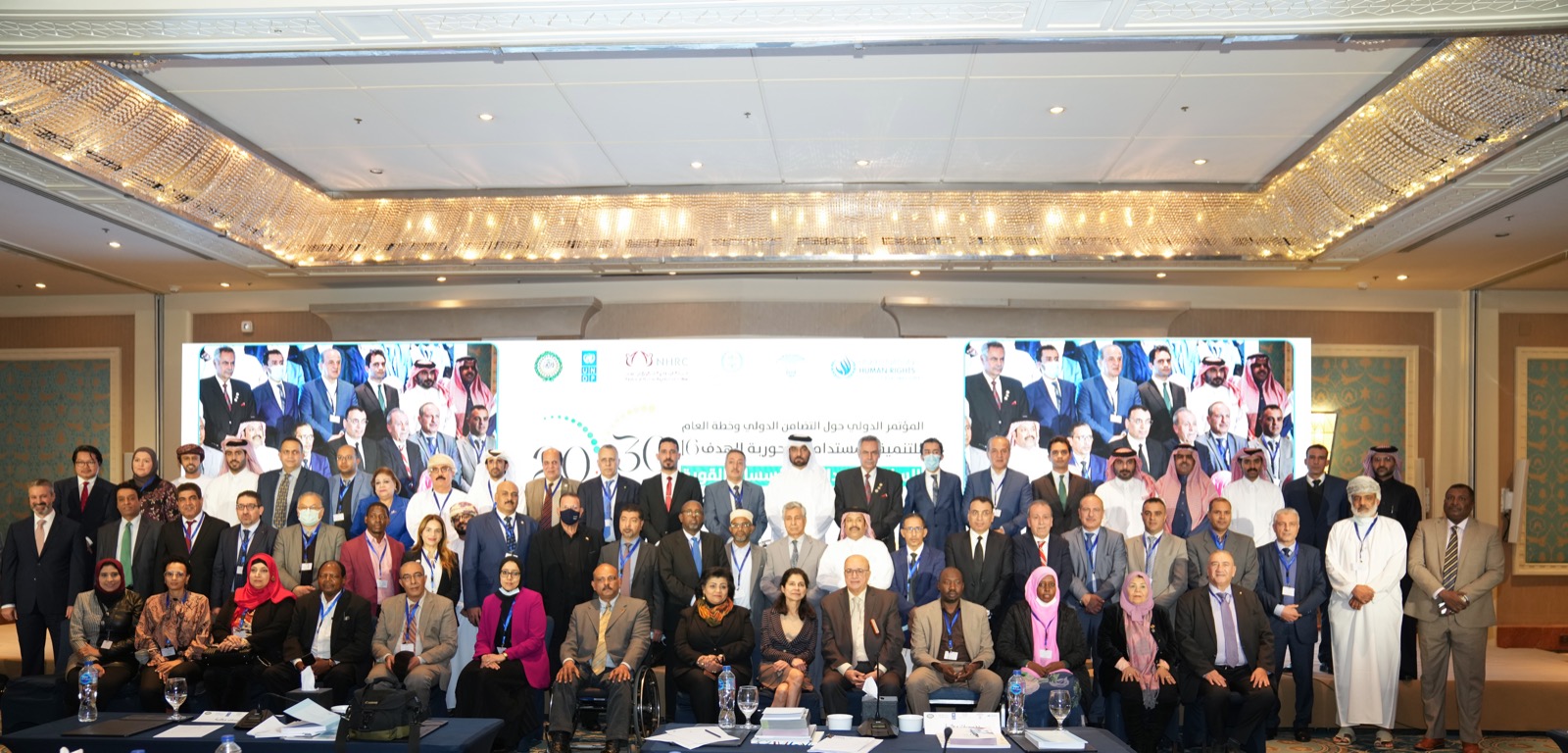
The Arab Network for National Human Rights Institutions (ANNHRI) and the National Human Rights Committee (NHRC) in the State of Qatar organized the “International Conference on International Solidarity and the 2030 Agenda for Sustainable Development: The Pivotal Importance of SDG 16: Peace, Justice and Strong Institutions,” in cooperation with the National Council for Human Rights in Egypt, Arab League, OHCHR, UNDP. The participants in the conference stressed the need for concerted efforts to address the roots and causes of conflicts and to strengthen Arab judicial cooperation as one of the keys to confronting the crime of terrorism.
The attendees demanded that the citizen as a “human” be the compass of governments when implementing SDGs. There is no value in achieving high economic growth rates, if such growth is not accompanied by economic empowerment of individuals. ensuring the enjoyment of civil and political rights, enabling them to express their opinions freely and to participate actively in decision-making.”
They emphasized that development is indivisible, and SDGs are interconnected so that one cannot be achieved without the other. However, they are aware of the pivotal importance of SDG 16 as a central SDG that lays the foundations of the achievement of other goals, and given that development cannot be achieved without achieving political stability, security and peace, establishing democracy and linking political systems their societies, and to address armed conflicts.
They underlined that the 2030 Agenda for Sustainable Development is perfectly a human rights agenda, and it mostly uses the same human rights tools and methodologies that NHRIS use in monitoring, reporting, measurement and reporting.
They noted that It is of paramount importance to involve HNRIs in monitoring, measuring and reporting on the 2030 Agenda as one of the levers and guarantees for achieving the Agenda at the State level, while promoting the role of HNRIs as one of the early warning mechanisms in identifying the main causes of human rights violations and the marginalization of individuals in their societies.
They clarified that serving the citizen and securing his needs is the compass that guides governance when setting plans and distributing the budget. Moreover, It is also more important that this is reflected in the services provided to the citizen, such as health, education, housing, while providing a decent life and sufficient share of income without discrimination, and achieving equality and social justice in a manner that preserves citizen’s human dignity. Besides, the government sector must be a partner in the struggle to achieve rights and integrated with other stakeholders.
Moreover, the attendees reiterated that stability and development of the region as a whole requires imposing a political path that allows for the settlement of the Palestinian Cause by ending the occupation and the Israeli apartheid regime against the Palestinians in all their places of residence, enabling the Palestinian people of the right to self-determination on their land, exploiting their natural resources, developing their national economy and bring about development. This will only be achieved if the international community assumes its legal and moral responsibilities and effectively intervenes in order to end and lift the siege imposed on the Gaza Strip and put pressure on the occupation authorities to compel them to respect the principles of international human rights and humanitarian law, as well as the importance of activating international accountability tools.
They went on to stress that the continued existence of armed conflicts, hotbeds of tension and the spread of terrorism and violent extremism is worrisome and an obstacle to development. It is also a violation of the right to development and the right to life. This entails concerted efforts to address the roots and causes of conflicts and to strengthen Arab judicial cooperation as one of the keys to confronting the crime of terrorism, along with the joint action to end the ongoing armed conflicts in the region.
The participants affirmed that it is imperative to work on all targets of SDG 16, to prevent violence and torture; to promote the rule of law and ensure equal access to justice for all; all types of crime, including human trafficking, corruption and bribery and to limit the flows of contraband; to ensure the protection of rights and freedoms; to ensure strong, effective, transparent and accountable institutions; and ensure public access to information, in accordance with national legislation and international agreements.
The conference papers and opening remarks included many recommendations, foremost of which are as follows: the continue the implementation of the recommendations of ANNHRI Conference held in Sharm El-Sheikh on 26-27 June 2019 on the “Role of NHRIs in implementation & follow-up implementation of the SDGs,” while considering them an integral part of the recommendations of this conference, and taking them into account with action plans to implement the recommendations of this conference.
Further, the attendees called for encouraging NHRIs to play an effective role at the national level in achieving SDGs, especially SDG16, through partnerships with stakeholders, NGOs and civil society in the Arab region in the implementation and follow-up processes, and effective contribution to technical and sectoral committees in order to stimulate the implementation of SDGs.
They also stressed the importance to integrate SDGs into NHRIs strategies and annual reports, and NHRIs must work to link the database of complaints they receive to SDGs indicators.
In addition, they ensured the necessity of cooperation among stakeholders to create the real political will for effective and well-managed government departments so as to address the root causes of the challenges that impede SDGs achievement; to reinforce the space available for civil society to transition to just, peaceful and inclusive societies; and to urge governments to strengthen democracy, freedom of opinion and expression, and combating and preventing torture.
The participants also emphasized the need to bolster the efforts exerted by NHRIs in the field of raising awareness about SDGs by boosting cooperation between NHRIs, official and civil bodies in order to implement the contents of the Arab Plan for Human Rights Education adopted by the League of Arab States 2022-2026.
The attendees asked the participating parties in the Conference, each within its area of competence and mandate, to seek to provide advice and technical support to governments in order to prepare and implement national action plans that take into account emerging issues in the field of human rights, especially with regard to climate change, violent extremism, artificial intelligence and cyber-attacks .
Besides, they reiterated the importance to support Palestinians to approach the International Criminal Court to implement the principle of accountability and seeking justice in Palestine, while supporting the Commission of Inquiry formed by the United Nations Human Rights Council in the wake of the last May aggression by the occupying state. It is also imperative to reject the decision of the occupying authorities to label 6 Palestinian human rights, civil society and development institutions as “terrorist organizations,” and provide all possible support to the Palestinian Independent Commission for Human Rights and Palestinian civil society institutions.
The participants called on ANNHRI, in partnership with relevant international and regional NHRIs, to continue to build the capacities of Arab NHRIs in the field of implementing and measuring the 2030 Agenda for Sustainable Development, monitoring progress in its implementation, and facilitating the exchange of experiences in this field.
They urged NHRIs to play their role to support the implementation of SDGs by reviewing the legislative framework so that they are aligned with international human rights standards in response to SDGs. Thus, this will lead to drawing up public policies, analyzing their response to SDGs, monitoring the existence of effective NHRIs and the nature of their performance, and presenting a human rights vision, as well as developing national reports within indicators capable of evaluating the reality.
Also, they encouraged NHRIs to cooperate with the central statistical agencies in their countries and to establish MoU to provide quality statistical data that are responsive to the indicators of the 2030 Agenda for Sustainable Development, especially data on vulnerable or disadvantaged groups at risk of being left behind.
Moreover, they encouraged Arab States to work on updating statistical legislation in line with the changes, developments and emerging issues, particularly in the field of SDGs, marginalized groups, and human rights.
They encouraged central statistical bodies in the Arab countries to open up to the private sector, civil society, NHRIs and all partners in the process of providing data related to the Agenda for Sustainable Development and filling statistical gaps in this regard.
The attendees stressed the importance to encourage NHRIs to activate the “Arab Network for Legal and Judicial Cooperation in the Field of Combating Terrorism and Organized Crime” as one of the mechanisms under the umbrella of the League of Arab States.
They encouraged the international and regional organizations participating as partners in the Conference to work on the capacity-building of judicial authorities in terms of optimal use of state-of-the-art technology in judiciary and facilitating access to justice for litigants.
They urged countries to develop national plans for the implementation of Security Council Resolution 1325 on Women, Security and Peace, and the relevant Security Council resolutions related to women and youth, and to provide the necessary resources to implement those plans.
As well, they encouraged NHRIs to engage in mechanisms and arrangements for national reconciliation and transitional justice, whenever necessary.
They reiterated the importance of raising awareness of the role of NHRIs in observing human rights during elections, while urging and striving for more inclusive elections by activating the systematic handbook produced by ANNHRI.
They stressed the need to address violence against women and minorities during the electoral process; and expanding participation to ensure the participation of women and youth and access to leadership positions.
At the end of the conference, the organizers and participants extended thanks to the Arab Republic of Egypt for the kind reception, hosting and facilitation of the work of this conference.
The organization of this conference aimed to encourage Arab countries to achieve further progress towards implementing the 2030 Agenda for Sustainable Development, by providing resources, developing plans and implementing them in partnership with the various development sectors. Some international reports showed that the Arab region, despite the progress made in some areas, still needs more work to achieve SDGs by 2030.
The second day of the conference witnessed a session on “Pivotal Importance of SDG16” with regard to democracy, governance, transparency and combating corruption. The session was chaired by Mrs. Nihad Abu al-Qumsan, member of the Egyptian National Council for Human Rights. During the session, Minister Plenipotentiary Mr. Mounir El Fassi, Director of the Human Rights Department of Arab League, presented a working paper entitled: “The Efforts of the Joint Arab Action System in Promoting Education on Human Rights and Democracy.” Mr. Marc Titus Cebreros, Human Rights Data and Indicators Unit, Methodology, Education and Training Section, OHCHR, presented a working paper entitled “Education in the Field of Rights Human rights as a key strategy towards just, peaceful and inclusive societies: Role of NHRIs”.
Mr. Alaa Al-Armouti, Commissioner-General of the National Center for Human Rights in Jordan, presented a paper on the “Pivotal Importance of SDG 16 With Respect to Governance, Transparency, Anti-Corruption; and the role of NHRIs.” this is in addition to another paper presented by Ms. Malene Elias, Coordinator of Praia Group on Governance Statistics.
Moreover, Mr. Ahmed Reda, Director of the Legal Department of the Arab Organization for Human Rights (AOHR), presented a working paper entitled: “Role of Civil Society in Promoting Democracy, Governance, Transparency and Combating Corruption”.
The activities of the conference included a second session on “Statistics and Sustainable Development Indicators (Measuring SDG16)” and the importance of cooperation and interaction between NHRIs, civil society and statistics departments”. The session was chaired by Dr. Noha Bakr, member of the Egyptian National Council for Human Rights, during which a working paper was presented to Ms. Nevin Awad, Head of Sustainable Development Unit at the Central Agency for Public Mobilization and Statistics (CAPMAS). Mr. Al-Hadi Al-Saidi, Director-General of the Arab Institute for Training and Research in Statistic, presented a working paper on “Targets, Indicators and Statistical Challenges for Measurement.”
Again, Mr. Marc Titus Cebreros, Human Rights Data and Indicators Unit, Methodology, Education and Training Section, OHCHR, presented a working paper entitled: “Human Rights Approach towards Indicators and Data: Enabling Closer Cooperation between NHRIs and Statistical Offices”. In addition, Dr. Ammar Dweik, Director-General of the Independent Commission for Human Rights in Palestine, presented a working paper entitled “Following up, Measuring and localizing indicators in the Arab countries: Role of the Independent Commission for Human Rights and the Palestinian National Team for SDG 16.” Mrs. Heba Farid, Follow-up and Evaluation officer in the Independent Commission for Human Rights (ICHR) in Palestine, entitled “Strengthening the role of NHRIs in providing advice to the State and providing data related to the 2030 Agenda for Sustainable Development: Linking ICHR complaints database with SDGs indicators.”
Further, the conference also included a session entitled “No Development Under Israeli Occupation or Under Terrorism”, chaired by Mr. Muhammad Ensour, Head of the Middle East and North Africa Division of the Office of the High Commissioner for Human Rights.
During the session, Mr. Michael Lynk, UN Special Rapporteur on the situation of human rights in the Palestinian Territory occupied since 1967, presented a working paper that dealt with the Israeli violations of human rights and the systematic arbitrary practices against the Palestinians.
For his part, Mr. Muhammad Mustafa Al Helow, Consultant in the Sector of Palestine and Occupied Arab Territories at the General Secretariat of the League of Arab States, presented a working paper entitled: “The Repercussions of Israeli Occupation on Development & Living Conditions of The Palestinian People.”
Mr. Essam Arouri, Commissioner-General of the Independent Commission for Human Rights in Palestine, also presented a working paper entitled: “Development in Palestine under the Israeli Occupation”. In addition, there were a working paper presented by Mr. Essam Younes, Director of Al Mezan Center for Human Rights in Palestine, entitled: “Occupation and Impossible Development – Gaza Strip as a Model”.
It is noteworthy that the conference was attended by experts and representatives of all the 15 NHRIs members of ANNHRI, a number of representatives of the NHRIs members of GANHRI, and NANHRI, as well as representatives of the Charter Committee, Arab Institute for Human Rights, and representatives of the Arab League and the host country – Egypt. It was also attended by representatives of statistics institutions and organizations, parliamentarians, human rights institutes, international and national organizations, civil society organizations, academic institutions, and development partners.
International Conference final statment 2022