Login
Signup
News
ANNHRI’s International Conference on Sustainable Development goals Off in Cairo
Cairo, 27 February:
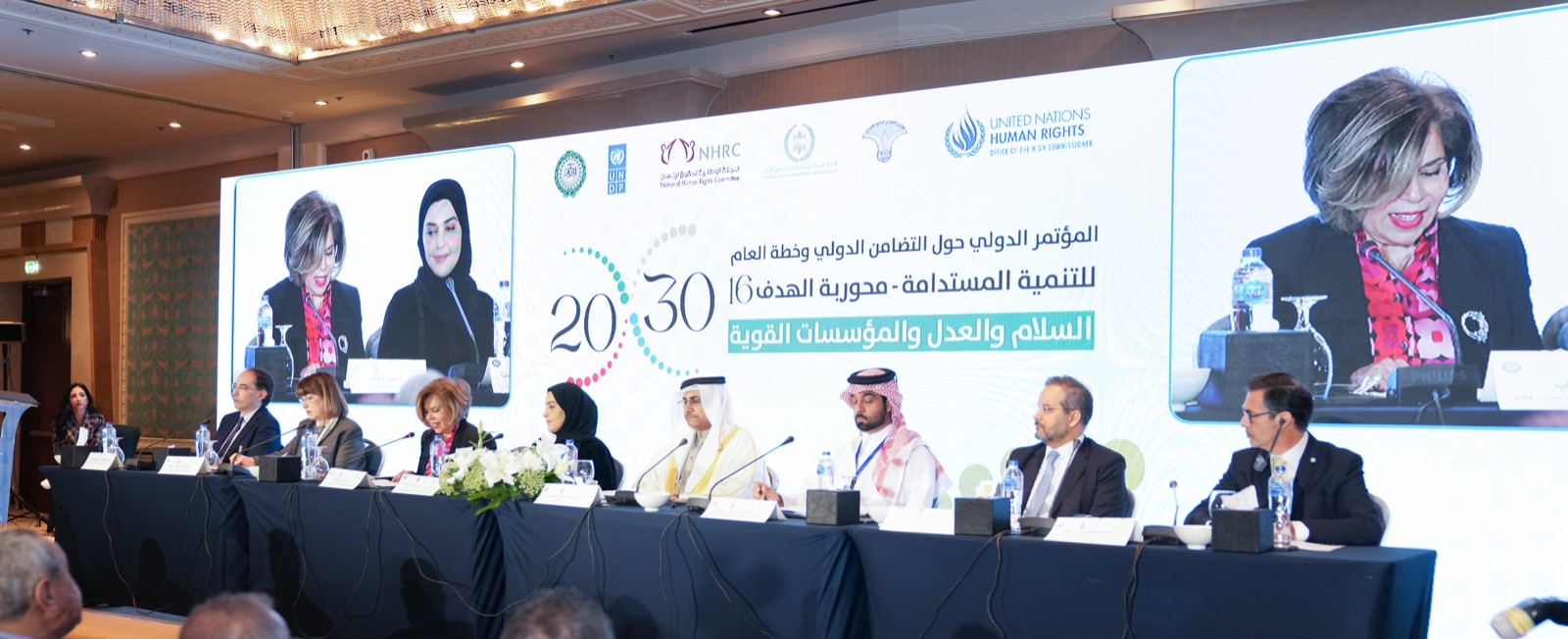
The “International Conference on International Solidarity and the 2030 Agenda for Sustainable Development: The Pivotal Importance of SDG 16: Peace, Justice and Strong Institutions,” kicked off today in Cairo. The Conference is organized by the Arab Network of National Human Rights Institutions (ANNHRI) and Qatar’s National Human Rights Committee (NHRC), in cooperation with the National Council for Human Rights in Egypt, OHCHR, UNDP and the General Secretariat of the League of Arab States.
The conference will be attended by experts and representatives of all the 15 NHRIs that are ANNHRI’s members, and representatives of GANHRI, its executive office and secretariats of the four regional networks accredited by GANHRI, as well as representatives of the Charter Committee, the Arab Institute for Human Rights, representatives of the Arab League and the host country – Egypt, statistics institutions and organizations, and parliamentarians.
H.E. Maryam bint Abdullah Al-Attiyah, President of ANNHRI and Chairperson of Qatar’s NHRC, stressed that promotion and protection of human rights is a global process, and the responsibility is collective. She underlined the importance of strengthening the capacity of NHRIs to implement and follow up on the implementation of SDGs.
During her speech at the conference, she expressed her hope that this conference will constitute a nucleus for continuous collective action and partnerships that contribute to strengthening the capacity of NHRIs to play their role in implementing and following up on the implementation of SDGs, by linking stakeholders in the national processes of implementation and monitoring in a transparent, participatory and inclusive manner.
She also expressed her hope that NHRIs will play a pivotal role towards encouraging their governments to work on the recommendations set forth in this regard at United Nations conferences such as the UN Conference on Trade and Development held in Doha in April 2012, which welcomed the accession of developing and Least Developed Countries (LDCs) to the World Trade Organization, and the importance of following up on the implementation of the Istanbul Programme of Action (IPoA) for LDCs.
She said: “The organizers of this Conference chose the theme: “International Solidarity and the 2030 Agenda for Sustainable Development”, being of fundamental importance and the basis for international cooperation and successful partnerships to support the development efforts of countries and to achieve SDGs. The 2030 Agenda for Sustainable Development is a global plan that can only be implemented through solidarity, international cooperation and collective action.”
She added: “SDG16 was selected as a central goal and a key to achieving other SDGs, through which we can expand civic space and political participation for all social groups, and combat corruption, polarization, discrimination and inequality.”
Then, she went on to stress that it is necessary to have the real political will to have effective government departments to address the root causes of these challenges and open up civic space; which are essential for the transition to just, peaceful and inclusive societies, enhanced by access to justice for all and building effective, accountable and inclusive institutions at all levels; institutions capable of providing support to achieve all 17 SDGs.
She added: “We cannot underestimate the importance of any of the SDGs; development is indivisible, and SDGs are interconnected so that one cannot be achieved without the other. To achieve development and leave no one behind (LNOB), so do not leave any goal behind, foremost of which is SDG16; since it is the secret of life and the goal that establishes the achievement of other SDGs.”
The Chairperson of Qatar’s NHRC added: “It is also time for the public sector to be a partner in the struggle to achieve rights and integrated with the rest of the stakeholders. This action requires partnerships between governments, the private sector, civil society, NHRIs and all stakeholders. These comprehensive partnerships must be built on rules, values, common visions and common goals so as to achieve sustainable and efficient development.”
Then, she expressed her hope that the conference will develop recommendations and an action plan to follow up their implementation. Moreover, she recommended that the citizen as a “human” be your compass, which will guide you with your recommendations. It is not important for the country’s national income to rise; rather, what is important is that this is reflected in the services provided to the citizen, including health and education, and in his adequate share of income without discrimination, in a manner that preserves his human dignity in his country and in the world at large.
For his part, H.E. Mr. Sultan bin Hassan Al Jamali, ANNHRI’s Executive Director, called for the promotion of democracy as one of the means to realize the political will so as to reach good governance.
Taking the floor, Al Jamali said: “Although SDGs do not explicitly include the human rights system, yet the issues they cover reflect the international human rights framework, including civil and political rights, as well as economic, social and cultural rights. Such SDGs included a fundamental dimension related to the protection and promotion of human rights, based on the UN Charter, the Universal Declaration of Human Rights and international conventions and treaties related to human rights.”
He added: “Within the framework of the ANNHRI’s implementation of its mandate to raise and build the capacities of NHRIs, it planned for the following: to work to raise awareness and educate about SDGs and work to build the capacities of NHRIs in this field; to brief NHRIs on the nature of their role regarding the follow-up to the implementation of SDGs in their countries; to exchange best practices and to see and evaluate experiences; as well as to introduce these SDGs and analyze and discuss the challenges facing NHRIs in this regards.”
He pointed out that institutional culture is a prerequisite for transparency and accountability. Therefore, transparency, combating corruption, and accountability are tools of good governance, which will focus on serving the citizen and securing his needs when drawing up plans and budgets.
He went on to stress that ANNHRI will continue its cooperation with its partners in the United Nations, the League of Arab States, civil society and relevant stakeholders in building capacities and exchanging experiences, and urging the development of practical plans that can be carried out by NHRIs to contribute to a human rights-based approach that will enable NHRIs to be viable, accountable and integrated into the implementation of the 2030 Agenda for Sustainable Development.
For his part, Director of the Human Rights Department of the Arab League Mounir El Fassi, said: “Human rights and development are inseparable and mutually reinforcing. Thus, the Right to Development is one of the basic human rights, as emphasized by the United Nations Declaration on the Right to Development (UNDRTD) and the “Arab Charter on Human Rights.” Rather, deepening the understanding of the UN 2030 Agenda for Sustainable Development is nothing but an enhancement of awareness of the culture of human rights in its comprehensive perspective.”
He added: “respecting human rights, activating the rule of law and combating corruption are essential factors in order to furnish a solid ground for achieving sustainable development by providing means of recourse to the judiciary. The right to litigation in its degree is guaranteed to all, and any exclusion, discrimination or marginalization may constitute a pretext for resentment, hostility or violence.”
He stressed that it is not possible in any way to accept or justify any act or threat of violence, whatever its motives or purposes.
He reiterated the need to strengthen solidarity and concerted efforts, regionally and internationally, to bring about peace and find radical, innovative and sustainable solutions to the escalating regional and global crises. This also shall include the adoption of development plans and strategies to ensure the protection of the right to a healthy environment and an adequate standard of living, with the engagement of women and youth, continuing efforts to develop the education system, and addressing the causes of extremism, and the promotion of a culture of dialogue and acceptance of the other.
He said: “The concerted efforts to activate the Arab legal and judicial cooperation network in the field of combating terrorism and organized crime has become one of the effective keys in order to thwart every criminal scheme that affects the safety of our societies and the unity and stability of the territories of our Arab countries.”
He noted that addressing security, justice and peace refers us to a pivotal issue, i.e. the daily suffering of the Palestinian people in their quest to secure their basic and legitimate rights that are being violated by the occupation authorities, let alone the economic and social difficulties resulting from the apartheid wall, and the continuation of the policy of settlements expansion on the OPT. Certainly, the stability and development of the entire region requires restoring the chances of a political track that would allow the settlement of the Palestinian cause.
In a related context, Ambassador Mushira Khattab, President of the National Council for Human Rights in Egypt, pointed out that the problem of population growth has become a huge burden on the economies of developing countries, and one of the forms of flagrant human rights violations, including the rights of children, youth and women.
The Ambassador added that the security turmoil experienced by some Arab states, and the ensuing armed conflicts, caused major security breaches, which definitely affected the lives of the citizens of those countries and deprived them of the most basic human rights.
Khattab stressed the necessity of maximizing efforts to bring peace to the region, in order to preserve the national state and the rights of its people, especially in that period when pandemics became a parallel world that required confrontation.
She called for the need to confront such critical challenges that require everyone to join forces and strengthen international solidarity and to redefine international peace and security in a way that alerts the Security Council to its responsibility.
Taking the floor, Head of the Middle East and North Africa Division of the Office of the High Commissioner for Human Rights Mohamed Ensour said: “Over the last decade, the Arab region has experienced unique circumstances that deserve to be studied in light of legitimate demands for a decent living and the provision of services There can be no development without human security, that is the absence of fear, the absence of indigence, and the preservation of human dignity.”
He added: “It is safe and peaceful societies whose members enjoy the benefits of development without undermining and excluding any rights. It is unlikely to attract investments to an environment where corruption is rife, and the independence of the judiciary is absent. There is no value in achieving high economic growth rates, if such growth was not accompanied by economic empowerment of individuals. ensuring the enjoyment of civil and political rights, enabling them to express their opinions freely and to participate actively in decision-making.”
Mr. Ensour went on to affirm the full belief of the United Nations in the important role played and assumed by NHRIs in supporting the 2030 Agenda for Sustainable Development, stressing the support of the United Nations for all national initiatives of these institutions.
As for Mr. Adel Abdel-Rahman Al-Asoumi, Speaker of the Arab Parliament, he said that there is an urgent need for concerted efforts to achieve the desired sustainable development. He added that there is indivisible connection between the realization of human rights and sustainable development, and the provision of job opportunities and putting in place legislation that achieve development aspects that benefit human rights.
During a speech he delivered at the conference, Al-Asoumi added that shedding light on peace and justice within sustainable development confirms the complementary relationship between sustainable development and human rights, as they are really two sides of the same coin. He pointed out that parliamentarians achieve this equation through legislation of citizenship and justice, provided that there is an integrated development vision, allowing fair and just distribution for development and guaranteeing the rights of present and future generations.
He stressed that the link between achieving human rights and sustainable development, providing job opportunities and putting in place legislation that achieve development dimensions, are things that benefit human rights.
On the other hand, Dr. Rania Al-Mashat, the Egyptian Minister of International Cooperation, said that achieving the 17 SDGs of 2030 is a concern of all countries, the United Nations and various international and regional institutions. In 2015, the world agreed to achieve these SDGs, through solidarity and joint action, in pursuit of a brighter future in which all enjoy justice, equality and the fruits of development.
In a recorded speech at the conference, Al-Mashat added that SDGs come on an equal footing in terms of importance and impact on the peoples of the world. However, SDG 16 related to justice, equality and strong institutions, acquires pivotal importance due to its extreme criticality as it is linked, one way or another, to all other SDGs. We cannot hope for sustainable development without peace, stability, human rights and effective governance based on the rule of law, and the upholding of the values of justice and equality.
She went on to explain that Covid-19 pandemic that affected the world at the beginning of 2020, despite its multiple negative effects on development; causing a decline in our gains from the efforts made over the past years, but it drew the attention of the whole world to the importance of exerting further efforts to achieve solidarity and promote joint action, and uphold the value of justice, equality and human rights in order to move forward towards overcoming challenges and putting aside divisions and differences to continue in sustainable development efforts in pursuit of a better future by 2030.
On the sidelines of the opening session of the conference, MoU was signed between ANNHRI and the General Secretariat of the Arab League. H.E. Mr. Sultan bin Hassan Al Jamali signed the MoU on behalf of ANNHRI, while H.E. Mr. Munir Al Fassi signed it for the Arab League on behalf of H.E. Mrs. Haifa Abu Ghazaleh, Assistant Secretary General of the Arab League.
This MoU comes in line with the objectives of the Arab Human Rights Strategy, which aims to enhance cooperation with NHRIs, and focuses mainly on strengthening capacity-building efforts in the field of promoting and protecting human rights in line with Arab priorities and concerns.
The MoU aims to instil and enshrine pride in the constants, values and identity of the Arab nation by coordinating positions to put human rights issues in the right context when they are raised in regional and international forums.
The MoU signed between the two sides is part of efforts to enhance communication between the mechanisms of the human rights system under the umbrella of the League of Arab States and NHRIs that are ANNHRI’s members.
Following the opening session, H.E Mrs. Maryam bint Abdullah Al-Attiyah held a series of meetings with heads and representatives of NHRIs participating in the conference, in addition to her meetings with partners and stakeholders. Al Attiyah met with H.E. Mr. Adel Al-Asoumi, Speaker of the Arab Parliament; H.E. Mr. Mounir El-Fassi, Director of the Human Rights Department of the League of Arab States; H.E. Mrs. Elena Panova, the United Nations Resident Coordinator in Egypt, H.E. Mr. Abdullah Al-Ajmi, Director of the Human Rights Department of the Gulf Cooperation Council; and Sheikh Dr. Hilal bin Saeed Al-Shaidani, Chairman of the Organizations and International Relations Committee of Oman Human Rights Commission, H.E. Mr. Luis Martinez, Electoral Program Advisor in the Arab countries and UNDP, and Dr. Maqsoud Kruse, President of the National Human Rights Authority in the UAE. The meetings discussed aspects of cooperation in issues of common interest, activating mechanisms for transferring experiences and exchanging best practices in the process of protecting and promoting human rights, as well as the role of NHRIs in implementing and following up on the implementation of SDGs, and coordination mechanisms to achieve the conference’s recommendations on the ground.