Login
Signup
News
ANNHRI Implements 3rd Phase of NHRIs TOT Program in Cairo
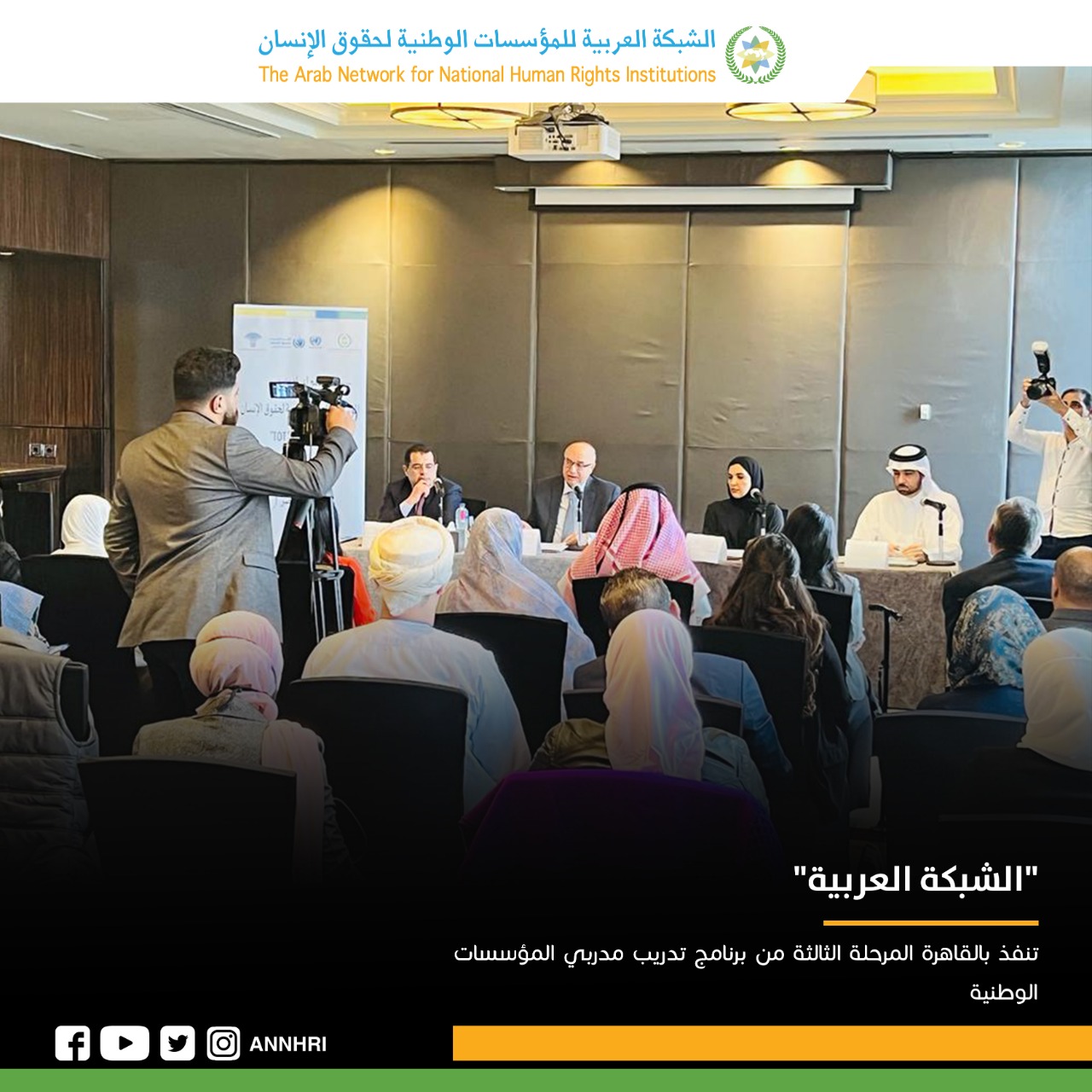
Maryam Al-Attiyah: ANNHRI’s programs aim to keep pace with global trends in the field of human rights
Al Jamali: Human rights awareness must be promoted among stakeholders
Karem: Putting into practice what was taught and trained during this training means effective NHRIs
Qaoud: OHCHR considers TOT as one of the interventions to address human rights issues.
Today, Doha-based Arab Network for National Human Rights Institutions (ANNHRI) implemented the 3rd phase of the NHRIs Course on Training of Trainers (ToT) in Cairo. The theme of the training course is “Designing, managing and providing training in the field of human rights” in cooperation with the United Nations Human Rights Training and Documentation Centre for South-West Asia and the Arab Region in Doha and the National Council for Human Rights in Egypt.
In her opening speech, H.E. Mrs. Maryam bint Abdullah Al-Attiyah, ANNHRI President, emphasized: “Through its programs, ANNHRI aims to keep pace with the major global trends in the field of human rights, along with providing advice and technical assistance to the member national institutions. To this end, ANNHRI’s strategic plan shall meet the basic needs of those institutions in terms of building, raising and refining capacities and skills.”
Al-Attiyah noted that ANNHRI, in its programs at the regional level, focused on exchanging experiences and best practices and training the trainers to find cadres capable of training, building and moving up capacities in various fields of human rights. This shall be implemented through ANNHRI’s framed partnerships with United Nations teams, agencies, commissions, bodies and councils. She said: “Such partnerships enabled ANNHRI to support the capacities of member NHRIs and enhance their capabilities to implement their tasks and programs, which will enhance the reality of human rights in their countries and the Arab region towards a rights-enhanced international community, where understanding and peace will reign.”
Al-Attiyah said: “The goal of establishing ANNHRI is to promote and protect human rights in the Arab region, by achieving a number of goals and carrying out a large number of tasks, in line with the broad mandate of NHRIs to promote and protect human rights in compliance with the Paris Principles of 1993.” She pointed out that building, raising and refining the capabilities of the ANNHRI’s members is one of the most important of these tasks. Through building and kicking up these capabilities, NHRIs will be able to carry out their tasks in an optimal manner and achieve their goals of promoting and protecting human rights in their countries. This is one of the ways through which ANNHRI works.
For his part, H.E. Mr. Sultan bin Hassan Al Jamali, ANNHRI’s Executive Director, said: “This stage complements the 1st stage that dealt with the issue of interaction with treaty bodies, and the 2nd stage that focused on the basic and everyday tasks of NHRIS, such as monitoring, visiting places of detention, receiving complaints, following up and preparing reports; as they are tasks that directly outreach the public and whose direct impact enhances confidence in NHRIs.” Al-Jamali pointed out that through this 3rd stage, ANNHRI and its partners in OHCHR, represented by the United Nations Human Rights Training and Documentation Centre, have completed this program by preparing and qualifying human rights trainers from cadres of member NHRIs.
Al-Jamali called on NHRIs that are ANNHRI’s members to invest their expertise in internal training across their institutions and at the national level to spread a culture of human rights, promote awareness of rights among stakeholders, and train them to respect such rights. He said: “ANNHRI considers all the experts and trainers of the Arab NHRIs to be its experts, given that the network is made up of these institutions.” He added: “Therefore, ANNHRI’s general administration intends to make use of the expertise of its member institutions by involving NHRIs trainers in its training programmes.”
In the same context, Ambassador Dr. Mahmoud Karem, a member of the National Council for Human Rights in Egypt, said that the TOT program will contribute to scaling up the capacities of the cadres of NHRIs and assisting them in carrying out their tasks in compliance with the Paris Principles. It will also enable these cadres to develop participatory approaches to spread and enforce the culture of human rights. He added: “I am certain that working on technical support and training NHRIs cadres and putting into practice what was taught and trained during this training is the basis for an effective NHRI that operates in accordance with the Paris Principles to achieve the main indicator of SDG 16, which affirms that peace, justice and strong institutions are the leaders of the promotion and sustainability of a culture of human rights.” Again, he pointed out that the training program hosted by Egypt coincides with Egypt’s great strides in promoting the march of human rights, the most important of which is Egypt’s issuance of the National Human Rights Strategy, which represents a national road map for the advancement of human rights, especially since its objectives will contribute to the promotion and spread of human rights is inside Egypt. Furthermore, it will be reflected in the frameworks of cooperation and progress in this field between us and all Arab countries and the world at large.
For his part, Mr. Alaa Qaoud, representative of the United Nations Human Rights Training and Documentation Centre for South-West Asia and the Arab Region, confirmed OHCHR’s interest in human rights training. He said: “Undoubtedly, training helps in the implementation of human rights. It goes without saying that training is only one among many possible interventions to work on addressing human rights in a country or society, or at the level of a particular group. Before deciding to undertake human rights training, it is necessary to analyze the context for which training is planned to be organized and the issue that the training seeks to cover.” Qaoud pointed out that OHCHR has paid growing attention to training methodology and its evaluation methods and tools. He said: “OHCHR has issued many publications in this regard, either individually or in cooperation with other parties, among which is “From Planning to Impact: A Manual on Human Rights Training Methodology,” which will be a pillar in this training course.” He noted that there are two other manuals; the Arabic version of which will be issued in the coming weeks, namely the “Training Evaluation Guidelines” and “Standard Settings Guideline”.