Login
Signup
News
ANNHRI organizes a conference to support Palestine
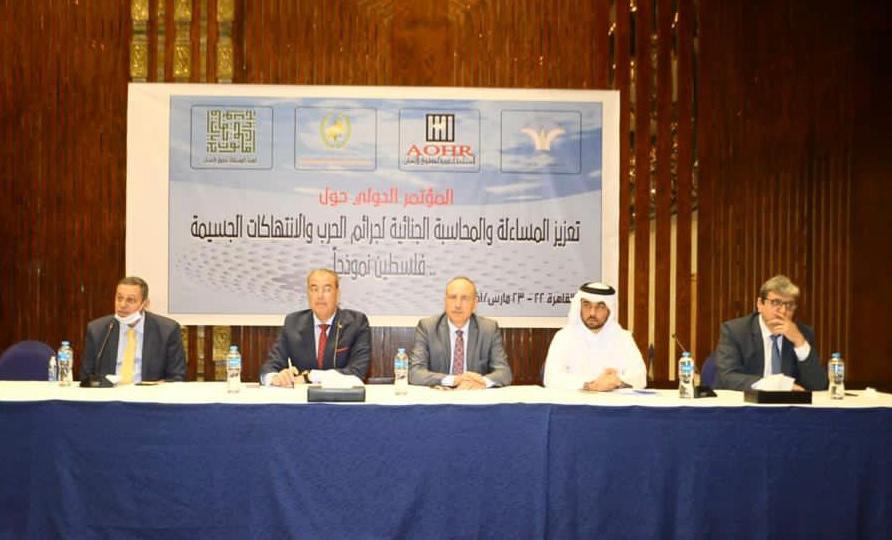
Cairo, March 23
The Arab Network for National Human Rights Institutions (ANNHRI), based in Doha, organized a conference entitled “Enhancing Accountability and Criminal Responsibility for War Crimes and Grave Violations … Palestine as a Model”, in the Egyptian capital, Cairo, in partnership with the Arab Organization for Human Rights and the National Council for Human Rights in Egypt, and the Palestinian Independent Commission for Human Rights on the 22nd and 23rd March.
The conference, which was held in Cairo, discussed the mandate of the International Criminal Court (ICC) and the applied experiences in a number of cases that witnessed addressing crimes similar to those committed under the Israeli occupation of Palestinian territories. Opportunities and challenges related to the mechanisms of implementing the decision of the ICC Prosecutor to initiate investigations in such crimes were discussed at the Conference, as well as the ways to intensify efforts to support ICC investigations, and mechanisms to expand the international alliance in support of the efforts to ensure accountability and responsibility.
Dr. Riyad Al-Maliki, the Palestinian Minister of Foreign Affairs, participated in the conference, together with a number of experts, judges and political science, international law, and criminal law academics, and leaders of non-governmental human rights organizations from Egypt, Palestine and a number of Arab countries.
In his speech, Mr. Issam Yunis, Head of the Arab Network of National Human Rights Institutions (ANNHRI), emphasized the important developments related to the Criminal Court with regard to the Palestinian question. He also explained that ICC is the last
resort for all victims after repeated violations committed in front of the world since the year 1967 until now.
For his part, Mr. Sultan bin Hassan al-Jammali, ANNHRI Executive Director, reviewed the network’s efforts in defending the Palestinian cause, pointing out that the network has adopted the Palestinian cause since the Israeli aggression on Gaza in 2014. ANNHRI convened in October of the same year, and confirmed the need for the Arab community to adopt explicit and strict policies to force international actors to end the illegal and immoral policy regarding Palestine. ANNHRI also called on Arab governments to take prompt legislative and judicial measures to ensure the adoption of the activation of the ICC jurisdiction, and to call on governments and civil society in Arab countries to provide the necessary support to strengthen legal action.
Participants agreed on a set of recommendations. Mainly, to welcome the ICC prosecutor’s decision to initiate investigations and the ICC Pre-Trial Chamber’s decision on jurisdiction ratione loci, which confirmed what the International Court of Justice (ICJ) affirmed in its Advisory Opinion in 2004. This represents a key additional asset for the protection of the right of the Palestinian people to their entire territory occupied in June 1967. Recommendations also affirmed that the Palestinian cause is a human rights cause and a cause of justice par excellence for the implementation of international legitimacy resolutions, and that the Arab conflict with the occupying authority shall not be resolved with financial or moral settlements or atonement as suggested by suspicious initiatives.
Participants also affirmed that national alignment in the face of the occupation is the only way to compel the Arab and international community to exercise their responsibilities towards the Palestinian cause.
It was also agreed to form a follow-up team consisting of the ANNHRI, the National Council for Human Rights in Egypt, the Independent Commission for Human Rights in Palestine (ANNHRI members), Al-Mezan Center, Al-Haq Center, and the Arab Organization for Human Rights, provided that the aforementioned team meets to set tasks, distribute roles and develop an action plan to support efforts before the ICC.