Login
Signup
News
ANNHRI Organizes a webinar to Rejecting Israeli Annexation plans in the occupied West Bank
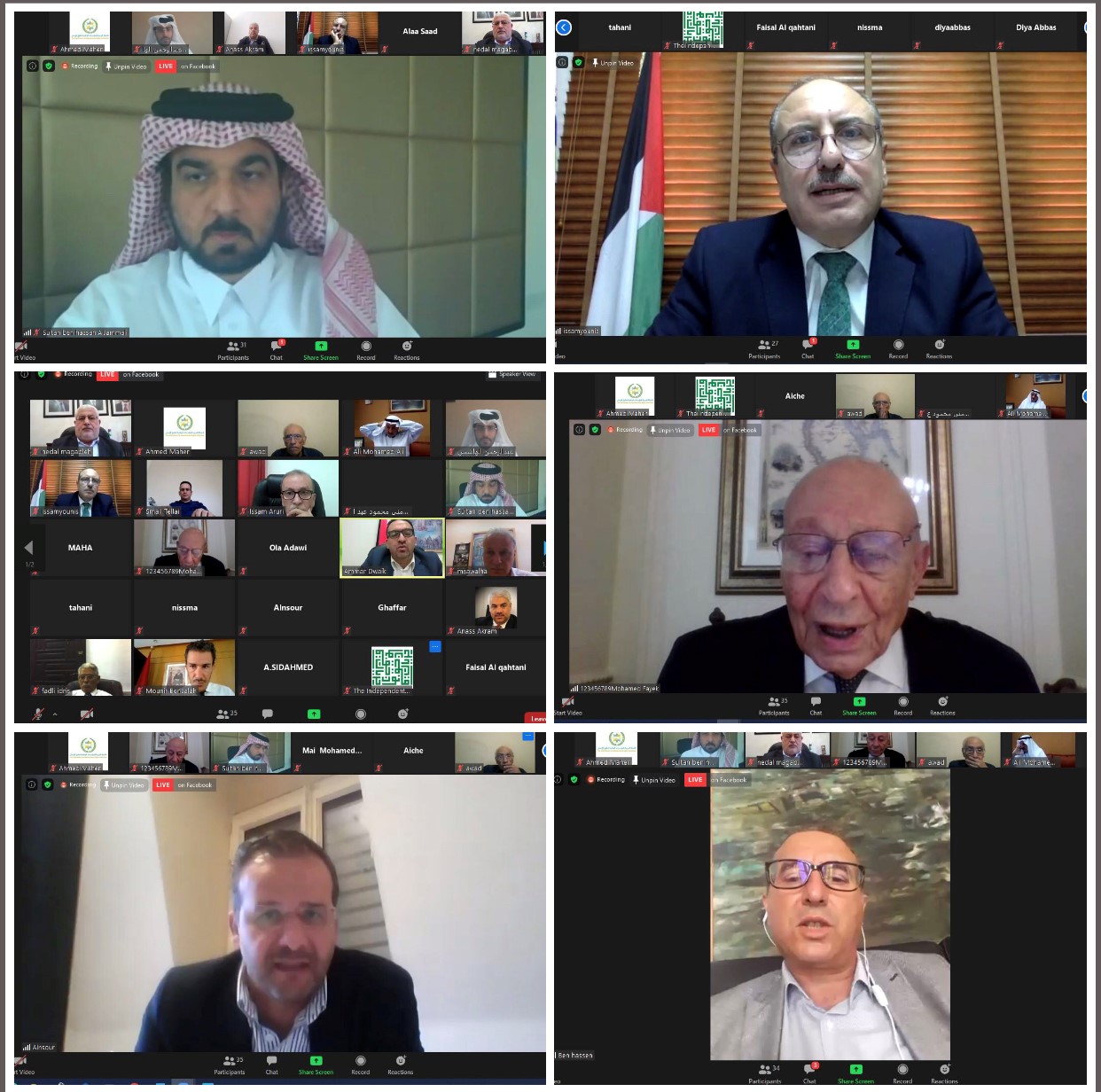
In a webinar convened by the Arab Network …
Issam Younis: Whoever is not punished will misbehave literature and Israel has “abused literature” over and over again
The legal decision of the annexation plan is a declaration of death and repulsion for the two-state solution process
Al-Jammali: The Israeli occupation was imposed as a fait accompli, and the global Zionism worked to stabilize it.
The Israeli occupation authority works systematically to transfer the “settlers” and build the annexation & Apartheid wall.
Fayek: Public, diplomatic and media pressure must be mobilized to urge the United Nations to impose an economic boycott on Israel
Al-Nsour: The High Commissioner for Human Rights has no need to be pressurized from anyone when it comes to the rights of the Palestinian people.
The High Commissioner for Human Rights will not be hesitated for work to abort the Israeli decision to annex the Palestinian territories
67 UN Special Rapporteur and working group stresses on the illegality of the annexing scheme
Al-Dweik: Some governments criminalize the Palestinian right to resist colonialism for political considerations
Doha: July 15, 2020
Mr. Issam Younis, head of ANNHRI – based in Doha – Chairman of the Independent Commission for Human Rights in Palestine said: “The world is lined up to reject the Israeli annexation plan. However, it seems as merely another move in the context of the plan announced by US President Trump named “deal of the century”. The plan means annexing parts of the occupied Palestinian territories, rendering the establishment of a Palestinian state an impossible process.
This statement was in the introductory word of the Arab Network webinar organized online on “the Israeli annexation plan of the West Bank territories”. Younis added: “ This graver decision had already in the making since 1967 when Israel confiscated the lands and built settlements by using circumvention, added to all sorts of vices and recent violations of international law, and the regulatory rules that the civilized world has consented to be bound by. Israel has now taken the most significant step, which is the legal annexation of the Palestinian territories. This is a serious development that rises up to the level of war crimes and violates the United Nations Charter, which affirms the impermissibility of acquiring the territory of others by force. He highlighted that although the world has been listening to what is happening in the Palestinian territories in cordial attempts to resolve the major issues in the conflict; Such as the legal position of the Holy City that was followed by the transfer of the American embassy to Jerusalem, and other pressing issues. However, in the dismissal of justice, its rules and the absence of accountability on the basis of he who gets always with his wrongdoing repeats it, Israel has committed wrongdoings again and again, thrived on failure of the international community to undertake its mandated role. He went on: “ We hope that this final step -the annexation plan – provides the world with the opportunity to move further towards achieving, delivering justice, since the current untenable situation implies a declaration of death and strangulating of a two-state solution, and constitutes a violation of the inherent rights of the civilian population protected under the rules of international law. He added: “We, as national institutions in the region and in the world, must show these facts and push the institutions towards regional and international mobility that fits the magnitude of this dangerous development. Younis alluded to the European Union’s rejection of the annexation decision and its study to take steps in this regard. He said: Until now these steps seem to be discouraging and not worthy of this serious violation of the rules of international law, which is a war crime par excellence. He added:” As national institutions, we have to push towards asserting the certainty, but a more effective role awaits us because the worst is coming if the situation remains as it is.
For his part, Sultan bin Hassan Al Jamali, Executive Director of ANNHRI – based in Doha – stressed that the Israeli occupation of the Palestinian territories was imposed as a fait accompli, and global Zionism with global imperialism behind it worked to establish that occupation, which was legitimized by the power and dominance of the colonial powers over the international community. It is now endeavoring to complete the scheme by stabilizing and legitimizing the occupation of the entire Palestinian land, including those occupied in 1967.
He explained that this forum expresses opposition to the practices and schemes of the Israeli occupation, and aims to expose its plan and shed light on the legal dimension and gravity of this situation if it becomes a status quo and to propose plans to undermine the occupation schemes, while emphasizing the fact that the establishment of the Israeli occupying power on the lands of 1948 was an occupation by force, killing, displacement, destruction, massacres and massive violations of human rights. He further said:” As usual, The Israeli occupying power is committing these violations in total defiance of the international law and the international community resolutions. The occupying power continues to do so while ridiculing the international community, international humanitarian law and human rights law, and without any regard to the international community. Therefore, pressure must be used to enforce the decisions of the international law in this regard.
Al-Jammali illustrated that the usurping occupying force works systematically to impose unlawful statuses on the ground by establishing colonies on the land occupied in 1967, transferring the “colonists” to reside there, confiscating lands, constructing the racial segregation wall. This is in addition to its practices against Palestinian citizens from denial of their freedom, adversely affecting their lives and personal security, obstructing their movement, and seizing them in their cities and villages.
He noted that in the year 1948, the occupying power invaded nearly 78% of the historical area of Palestine, uprooting the indigenous people from their cities and villages with the aim of replacing them with attracted Jewish immigrants. He continued: The power went on to occupy the rest of historic Palestine in 1967, achieving a large part of its colonial project, which is contrary to all international conventions, laws, and customs. The occupation continues to deny the Palestinian people of their right to an independent and fully sovereign state on the borders of June 4, 1967, as acknowledged by the international legality.
In the same context, His Excellency Mr. Muhammad Fayek, President of the National Council for Human Rights in the Arab Republic of Egypt, stressed that the occupying annexation project is rejected by Palestinians and Arabs and said: “There is no other way or alternative but the resistance” and that needs financial and material support from the Arab states to the Palestinian people, to ensure Life continuance in Palestine. He added: The occupying force will put severe pressure on the Palestinian people and their lives until they accept to sell their homeland for the fifty billion dollars declared. By the mere effect of the fact, “These people do not understand that the homelands are not sold”. Fayek urged the Palestinians to drive national reconciliation and said:” Reconciliation and National unity has become a dire need in this critical stage”. He also called for advocating in every possible way, publicly, diplomatically, and medially, to induce the United Nations towards imposing an economic boycott on Israel. He further said: “This matter may take time. However, the international public opinion is shifting and there will be an initiative by a few influential figures to induce the United Nations to formulate a statement to prepare the world to put pressure on Israel.
For his part, Mr. Mohamed Al-Nsour, Head of the Middle East and North Africa Division, confirmed to the Office of the High Commissioner for Human Rights on the standing position of the High Commissioner for Human Rights against the annexation plan from the first day of announcement that has been declared in the statement of High Commissioner Michelle Bachelet. The position expressed the illegality of the annexation decision not only under international law and international humanitarian law but rather comes inconsistent with Security Council resolutions and the United Nations Charter, which explicitly includes the impermissibility of acquiring the territory of others by force. He pointed out that this statement was a watershed in resolving the legal debate that revolved with the beginning of the announcement of the annexation plan, especially in light of the talk about the progression of annexation in different proportions which does not entail the legality of the annexation decision in any way.
Commenting on Mr. Mohamed Fayek’s proposal to pressure the United Nations, Al-Nsour said: The commission has no need to be pressurized from anyone when it comes to the rights of the Palestinian people and their right to self-determination. Al-Nsour continued: “As for the issue of the economic boycott of Israel, it requires a decision by other UN bodies higher than that of the High Commissioner and the Human Rights Council. Al-Nsour said: Also, an important joint statement was issued by 67 special rapporteurs and working groups of the United Nations, who together represent all the international human rights mechanisms, which is the first time that all the special mandate-holders of the United Nations system have gathered to issue a joint statement. He added:” This statement included important topics; the first is to emphasize that the annexation scheme is a violation of international law, international humanitarian law and human rights, and a embodies inequality in the legal systems that people of the west bank fall under. Al-Nusour called for a need for reflection on this issue with a view on post the annexation and how to act from a legal standpoint. He urged the national human rights institutions to look upon the importance of thinking about how to support national efforts to restore interest in the Palestinian question and rethinking the legal principles of the rights of the Palestinian people. He went on:” National human rights institutions have a crucial role in pressing to keep the matter among the national, regional and international priorities, and not to leave it at reactive responses. He further stressed the concern of the High Commissioner for Human Rights to support this move and said:” At the Commission, we will not delay any call to discuss the rights of the Palestinian people and enable them to obtain those rights and take any preventive measures to subvert Israeli decisions to annex the Palestinian territories. Al-Nusour thanked ANNHRI for inviting him to participate in this forum, which he described as a critical topic that is sensitive not only to the Palestinian people but to the peoples of the region as a whole.
For his part, Dr. Ammar Dweik, Director-General of the Independent Commission for Human Rights, reviewed a paper on the scenario of occupying annexation and its impact on the rights of the Palestinian people and the future steps. He illustrated that the matter of annexation has been a core topic at the table of successive Israeli occupation governments since 1967. He also gave an explanation about the definition of annexation in terms of international law, pointing out that international law distinguishes between actual and formal legal annexation, indicating that actual annexation is an ongoing and progressive project since the occupation of the West Bank in 1967. He further said: “International law describes the annexation as a violation of the right to self-determination of the Palestinian people, as well as a breach of many international covenants and agreements such as the Hague Convention 1907, the Fourth Geneva Convention 1949, the decisions of the International Charter, the Rome Statute and the advisory opinion of the International Court of Justice and other international agreements. Dweik discussed in his paper an explanation of the map of settlement expansion, and the goals and policies of that expansion, as well as the number of settlers and outposts. He also touched on the current annexation declaration and its scenarios. Dr. Ammar Dweik reviewed a set of recommendations, including holding the position rejecting the annexation decision in all its forms, being a material breach of the principles of international law and the Charter of the United Nations. Furthermore, the need for all countries to adhere to the relevant Security Council resolutions and the commitment of all states that have agreements with Israel to the principle of distinction between the lands of Israel and the Occupied Palestinian Territory Including East Jerusalem. This is in addition to the importance of political forces and civil society organizations to respond to the attempts of some governments – left out their names – to criminalize the right of the Palestinians to resist colonialism, an act that violates international law or criminalizing the boycott of Israel for political and moral considerations, based on the notion that it is a violation of the basic rights of citizens in the boycotting countries. In his recommendations, Dewik urged countries that have relations or agreements with Israel to take punitive measures against it on the basis of those agreements if Israel goes further with the annexation plan.
The webinar included speeches by the heads of national human rights institutions and their representatives and a number of other organizations, including Mr. Ali Al-Baghli, member of the National Diwan for Human Rights in the State of Kuwait, Mr. Alaa Shalabi, head of the Arab Organization for Human Rights, Dr. Rahil Gharaibeh, head of General secretary Council, the National Center for Human Rights in Jordan, and Mr. Abdul Basit Hassan, president The Arab Institute for Human Rights, Mr. Idris Fadli, Chairman of the Standing Committee for Legal Affairs of the National Council for Human Rights in Algeria, Dr. Anas Al-Azzawi, member of the High Commission for Human Rights in Iraq