Login
Signup
News
The ANNHRIs organizes a symposium on “Just Peace for the Middle East Region” at the UN Headquarters in Geneva on March 6, 2019
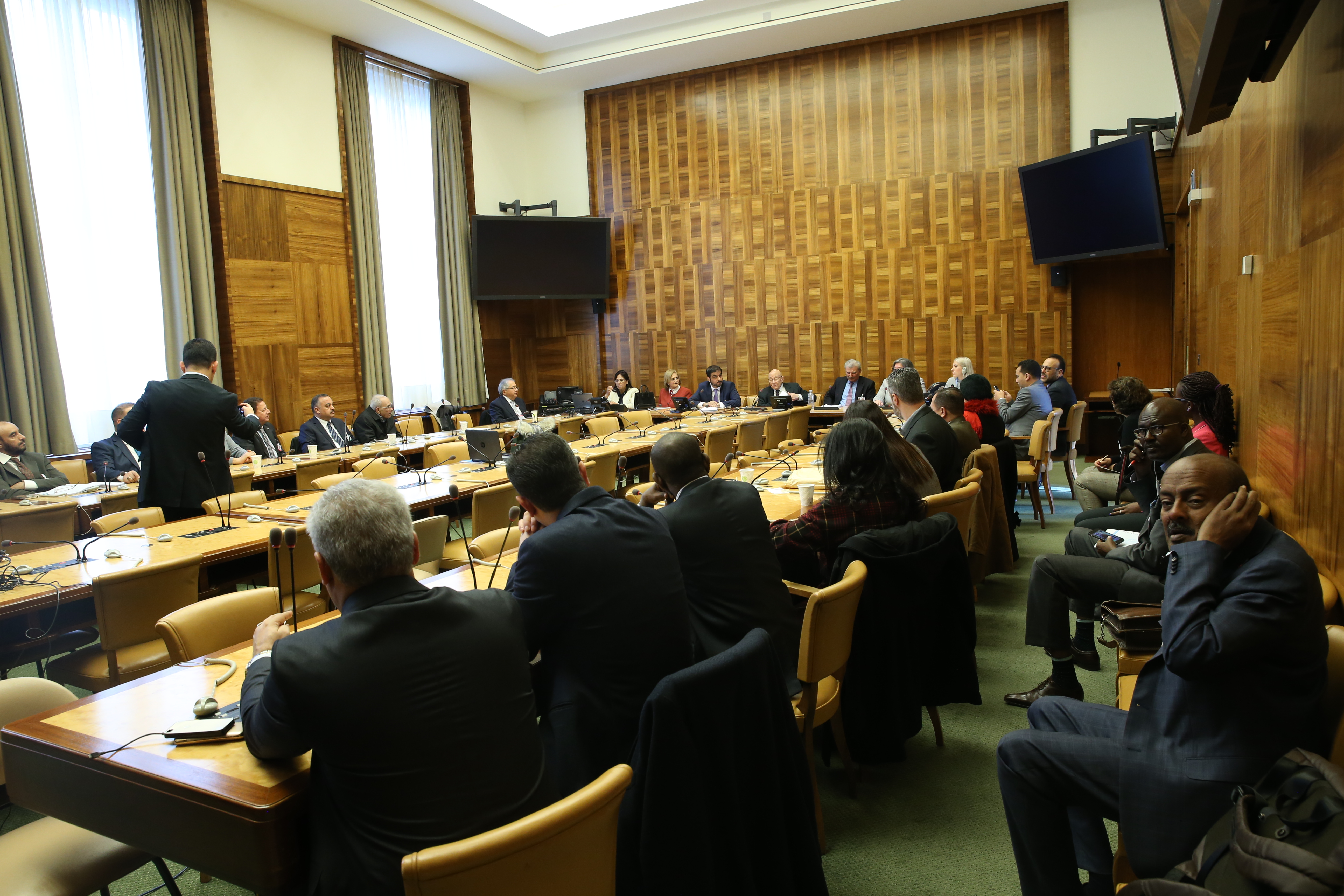
Geneva: March 6, 2019
Mr. Sultan bin Hassan Al-Jammali, Executive Director of the ANNHRIs affirmed that the occupation, wars and conflicts that violate all human rights stipulated in international laws and covenants, motivate us to cooperate all in order to achieve a just and comprehensive peace. A peace that is sustainable, and that does not condone or cede rights, or even a part of a right. ”
He pointed out that “peace is not just a mere word, but rather one of the factors of state stability, the pillar of stability of peoples’ lives, and the basis for development and development. So; the real leader is the one who makes peace, not the one who wages wars.”
Al-Jammali expressed that opinion during the symposium organized by the ANNHRIs on “just peace for the Middle East region” at the UN headquarters in Geneva on March 6, 2019. The symposium was organized in order to discuss and emphasize on the issue of just peace as a basic pillar for the stability of peoples and building societies. The symposium was held based on the decision of the ANNHRIs General Assembly at its last meeting in Cairo.
About 45 representatives of human rights institutions from Arab countries as well as African and Asian networks attended the symposium. In addition, a number of human rights activists and civil society representatives also attended, and rich discussions were held about the violations that affect the Palestinian people. The speakers stressed that such violations make the talk about establishing a just peace in the Middle East a fantasy.
For his part, Mr. Mohamed Fayeq, President of the ANNHRIs, and Chairman of the NCHR in Egypt, said: “The symposium is important to discuss ways to confront the American Zionist project, to obscure the inalienable rights of the Palestinian people, and to try to impose the fait accompli and support the occupation. This transcends all United Nations resolutions and Arab-Arab initiatives to achieve a comprehensive and just peace.”
Addressing the official of the NHRIs, he added, “Seeking from the International Criminal Court to expand the scope of the crimes presented to it is not inconsistent with launching a diplomatic campaign to hold a meeting of the High Parties to the Geneva Convention to affirm the protection of the Palestinian people. Nor is it inconsistent with seeking an advisory opinion with the International Criminal Court to expand the scope of the crimes before the court over the unprecedented continuation of the occupation of the Palestinian territories.
Mrs. Amna Bouayach, President of the NCHR in Morocco, also proposed that the ANNHRIs adopt a mechanism for pleading in coordination with the National Foundation for Palestine. This mechanism is regarding the activation of the Human Rights Council decisions in relation to the protection of the rights of the Palestinian people with all parties concerned with protecting and promoting human rights at the international level for the protection of the Palestinian people and their enjoyment of their right to peace in accordance with international human rights law.
She also called for following up on the implementation of the recommendations and decisions of the treaty mechanisms regarding support for peace and security for the Palestinian people; Preparation of a program to strengthen capacities in the field of the right to peace and mechanisms to broaden the base of those involved and their advocates.
Mrs. Mervat Rishmawi, member of the Independent Commission for Human Rights in Palestine, stressed that “peace is not a conceptual issue but a fact and is only realized by those who live under the Israeli occupation, and there is no peace under the occupation.” She further pointed out, “all human rights mechanisms and the Security Council considered the Israeli violations an obstacle to peace, such as the continuous expansion of Israeli settlements, without punishment that changes the reality on the ground, which means that there will be no lasting peace.”
She further noted that, “human rights mechanisms must become alert to the continuing violations in Palestine. Although all international human rights mechanisms denounce Israeli violations, and the International Court of Justice said that this hinders the achievement of peace in the region, the occupation continues its violations, not caring about the international community.”
Mrs. Fafa Bin Zarki, President of the NCHR in Algeria, explained that, “a just peace directly compels us to address the Palestinian issue and the continuation of the conflict, in the absence of prospects for a future settlement. It is noticeable that the succession of major crises may give some the wrong impression that the Palestinian issue has retreated, and this is a grave mistake for those who know the Middle East region and realize the impact of the Palestinian issue and its developments to this day.”
“Finding a just settlement of the noble cause,” She added, “remains the shortest path to achieving peace in the Middle East. Without a just and lasting settlement of the Palestinian issue, there will be no stability or just peace in the Middle East region.”
“After a quarter of a century of negotiations between the Palestinians and Israelis,” She concluded, “with all the resulting decisions and initiatives enough to resolve the articulated issue, it is not possible to continue another quarter of a century of negotiations and decisions. Peace cannot be established in the Middle East until the Israeli occupation of the Palestinian territories ends.”
Dr. Musa Al-Braizat, Commissioner-General of the NCHR in Jordan, stressed that “peace must give an equal balance of power to Palestinians and Israelis, and this is actually not the case. Rather, there is peace imposed on the Palestinians, and we are closer to a stage of neither peace nor war, and the continuation of conflict and occupation.”
“The Arab Network must focus on what it can do,” He continued, “and think about a way for the Palestinian issue to be an Arab international issue and defend the right of the Palestinian people to self-determination for it is a universal right.”
“There are many obstacles,” He added, “and the Israeli occupation did not recognize the existence of a Palestinian people, and later it was looking to integrate it into Jordan. Today there is recognition of the existence of a Palestinian people, but the occupation is striking at all the resources and infrastructure of the Palestinian people. UN resolutions are no longer sufficient, and they need the support of the major powers in the Security Council for being imposed. Hence, the right to self-determination must be linked to achieving international peace and security.
“A recommendation can be made,” He concluded, “that adopts the Palestinian issue as transnational, and no Arab country should make concessions, including stopping normalization with the Israeli occupation. We should not make excuses for any Arab country normalizing with the occupation, since it is the most important weapon in our hands. In light of the Arab community’s categorical rejection of normalization, we can draw up a plan to defend the right of the Arab peoples to reject normalization, and prevent Arab official initiatives that neglect the rights of the Palestinian people.