Login
Signup
News
The Arab Network organized an awareness seminar on its activities and its role in Geneva on 11 September 2017
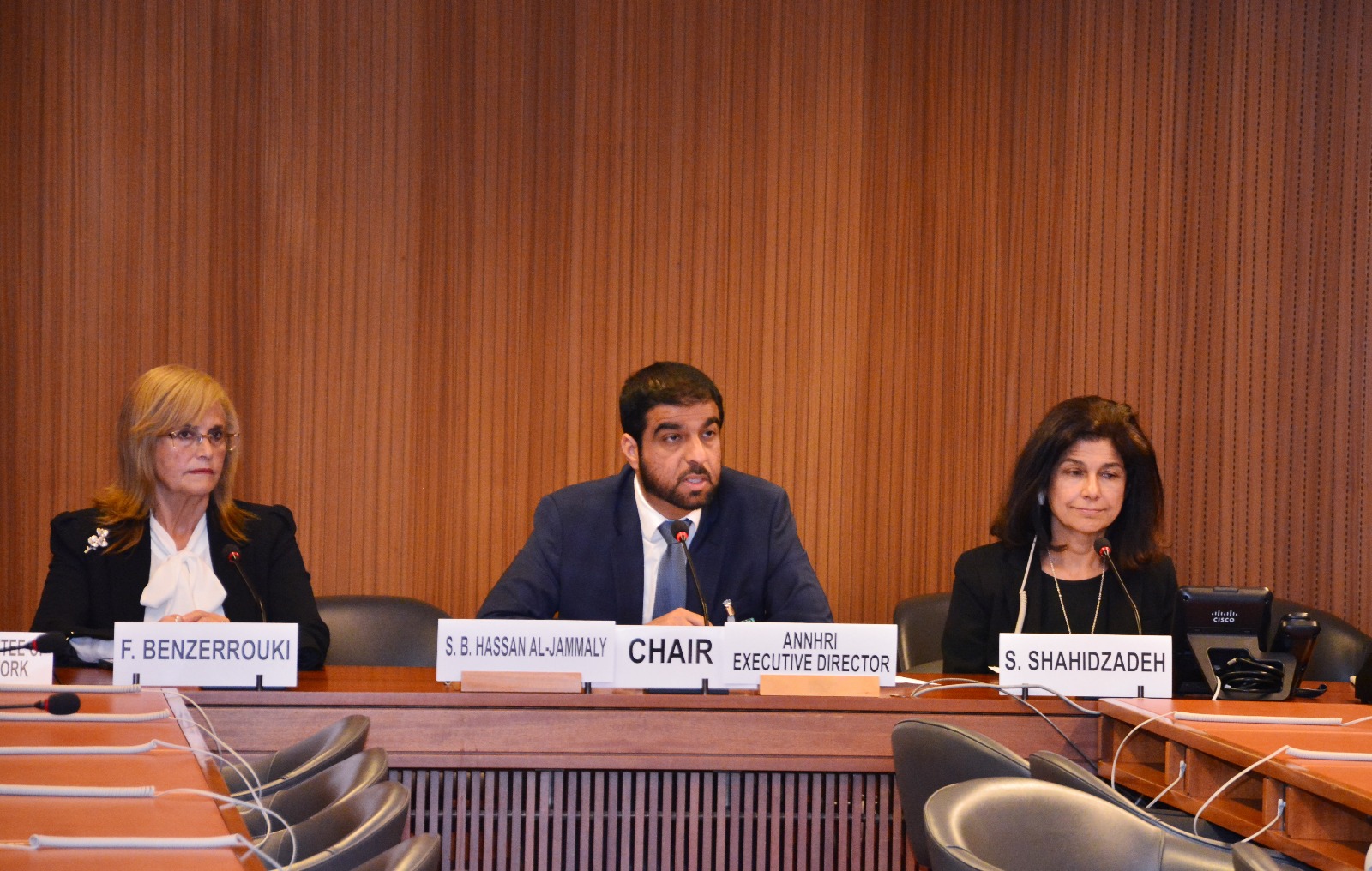
The Arab Network organized a seminar on the network and its role in the promotion and protection of human rights in the Arab region at the United Nations headquarters in Geneva.
The seminar, which was organized in cooperation with the Office of the High Commissioner for Human Rights in Geneva, aimed to familiarize participants with the role of the network in the field of human rights, its functions, objectives, activities and areas of cooperation with its partners, as well as its achievements, plans and programs.
The seminar, which was attended by many international delegations representing human rights organizations and institutions in the world, highlighted the role of the Arab in the field of the promotion and protection of human rights in the Arab region.
In a speech at the opening of the seminar, Mr. Sultan bin Hassan Al-Jamali, Executive Director of the Network, said that the Arab network of national human rights institutions through the distribution of its member institutions in Asia and Africa has a great scope of work, through which greater cooperation and exchange of experiences and best practices can be achieved.
Al Jamali added that the network through its various organs works to achieve its objectives by performing several tasks, the most important of which is to encourage the establishment and strengthening of national institutions in accordance with the Paris Principles, providing them with advice, expertise and support to national institutions with limited resources and problems in performing their mandates.
Al Jamali pointed out that the Arab Network also works to strengthen cooperation and coordination between national institutions and the Global Alliance of national human rights institutions and relevant international and regional organizations, as well as to encourage the effective participation of national institutions in international and regional forums and meetings of the Global Alliance.
Al-Jamali noted the role of the network in building and strengthening the capacities of its member institutions in all fields of human rights through training courses, workshops and dialogue tables in order to enable them to carry out their mandates and to facilitate their access to the accreditation by the Global Alliance, and work professionally to achieve the ultimate goal for which national institutions have been established, which is the promotion and protection of human rights in their countries.
Al-Jamali explained that the Arab works with its partners to achieve its objectives, as it had many fruitful cooperation with the High Commissioner for Human Rights, the United Nations Development Program and the human rights networks adopted by the Global Alliance.
Al-Jamali also pointed out that the network has signed a number of memorandums of understanding with its partners in the framework of activating cooperation. In addition, it organized dozens of workshops and training courses aimed at building and raising capacities of member NHRIs. It also participated in organizing several important dialogues and conferences, including The conference on the development of the human rights system at the League of Arab States, hosted by Doha in 2013, the International Conference on the Arab Court for Human Rights in the Kingdom of Bahrain in 2014, the first and second international conferences on the challenges to security and human rights in Doha in 2014. He added that the network also contributed to the organization of the international conference on the role of the High Commissioner for Human Rights in the Arab region in Doha in 2016, the Arab Ibero-American dialogue of the national human rights institutions on hate speech held in Doha in 2015, as well as the International Conference on Human rights-based approach to conflict situations in the Arab region. Al Jamali stated that The Network looks forward to greater and more effective cooperation with the Global Alliance of National Institutions, International and Regional Human Rights Organizations and its Executive Bureau.
The participants in the seminar were briefed on the role and activities of the Arab network, and its efforts in the field of promoting human rights and supporting the concerned institutions in the Arab world. The seminar was held in the context of the network’s dissemination, enhancing its role and presence, and raising the percentage of the segment aware of its role, in the framework of working to find greater support for it and its role in the promotion and protection of human rights in the Arab region, in addition to opening new horizons for future cooperation with all stakeholders who intersect Their interests and goals with the objectives of the network and vision.
In a speech during the seminar, Mr. Khalid Al-Ramli, representative of the National Council for Human Rights in Morocco, said that this meeting is an important opportunity to introduce the efforts of the Arab Network and its activities in the Arab region.
In this context, he also reviewed the cooperation between the National Council for Human Rights in Morocco and the Arab Network, especially that the National Council has been close since the beginning of the discussions and meetings that preceded the establishment of the network, where he was a partner in its founding conference.
He said that the Arab Network, although it is considered among regional and sub-regional networks, was able, in a short period of time, to carry out an important group of activities that dealt with human rights issues of interest to the Network, including capacity building through a series of workshops and training courses in partnership with several actors in the field.
Ms. Afarin Shehidzadeh, Deputy chief of the National Institutions and Regional mechanism Section of the Office of the High Commissioner for Human Rights, said that the National Institutions Section provided advisory services to national authorities for the enactment of laws and decrees for the establishment of national human rights institutions, as well as for amending legislation to bring it into conformity with the Paris Principles. She referred to cooperation in technical support programs with a number of national human rights institutions in the Arab network. She added that this cooperation is very important because of the belief in the importance of the role of national institutions that play a key role in guaranteeing and preserving human rights. These national institutions served as the bridge within society, which linked the Government and Parliament to the administration of justice, as well as with the civil society, as well as regional and international human rights systems. Shehidzadeh stressed that there is great interest and keenness of the Office of the High Commissioner for Human Rights to cooperate with the Arab network for national human rights institutions, in order to achieve the advancement of human rights issues and protection in the Arab region.
Ms. Fafa Ben Zerrougui, President of the National Council for Human Rights in Algeria, said that the role of national human rights institutions is very important because human rights issues affect the daily lives of societies and it is therefore important and necessary to work collectively on such issues, noting that the efforts of the Arab Network have made a quantum leap in the field of human rights protection in the Arab region through coordination and cooperation between national institutions in these countries.